Curated cybersecurity briefings on active threats, vulnerabilities, and emerging risks
Weekly Cybersecurity Briefing (12 October – 18 October 2026)
Published: Loading…
This briefing covers 286 reports published from 12 October to 18 October 2026.
At a Glance
- Attackers abused the defrost function in Danfoss refrigeration control software, spoiling stock at hundreds of French supermarkets across several chains.
- Ledger confirmed a hardware implant in a wallet sold through reseller CryptoBilis, with a blockchain investigator estimating losses above $86 million.
- A stolen ConnectWise Cloud Backup application credential gave an attacker access to at least 162 Microsoft 365 tenants without triggering MFA.
- Suspected China-nexus actor ARMORY CASTLE exploited a BeyondTrust Remote Support zero-day, CVE-2026-102764, from late August, before the vendor's 8 October patch.
- Ivanti Connect Secure zero-day CVE-2026-104935 was added to CISA's KEV catalogue after attackers chained three flaws to run commands as root.
Editorial Analysis
The Danfoss attack on French supermarkets caused reported stock losses across hundreds of stores, with attackers manipulating refrigeration controls to force continuous defrosting. Around 300 Intermarché and Netto stores and fewer than 100 Système U stores were initially reported affected, with later reports naming Coopérative U, Carrefour, E.Leclerc and Monoprix. Some accounts described defrost cycles extended from one hour to eight, delaying alarms and leaving staff less time to respond. The retailers do not share a parent company, pointing to their common supplier as the connection. Danfoss says affected stores were running outdated firmware, but authorities have not confirmed whether vulnerabilities disclosed in 2025 were used or identified the attacker. ANSSI is working with European counterparts to establish whether the same software versions are deployed elsewhere.
Ledger confirmed that a hardware wallet sold through Southeast Asian reseller CryptoBilis contained an unauthorised implant. The company says its own systems and direct sales channels were unaffected, and all confirmed cases involve devices sold through that reseller. The stage at which the implants were added and the number of affected devices remain unknown. Estimates of suspected cryptocurrency losses also differ, with on-chain researchers putting them above $93 million, compared with an earlier estimate of more than $86 million cited by The Hacker News. Ledger has paused sales through CryptoBilis, which has stopped selling all hardware wallet inventory. Ledger advises affected customers to move their funds to a new device using a new seed, as a seed generated on a tampered device cannot be considered secure.
The ConnectWise Cloud Backup compromise affected at least 162 customer tenants, according to Huntress, while other reports cite 173. Sign-ins from a single hosting IP address occurred over roughly two hours on 15 October. The attacker used the application's own credential, authenticating without a user session, device check or MFA prompt and inheriting permissions already granted by customers. In one tenant, a second ConnectWise application granted itself Global Administrator and added client secrets to two other trusted applications. This activity created additional access paths beyond the original credential. Previously issued tokens can also remain valid for up to 90 minutes after an application is disabled. ConnectWise has not disclosed how the credential was obtained and reports no evidence that partner backup data was compromised.
Highlights of the Week
Cyberattack on Danfoss Refrigeration Software Destroys Fresh Stock at French Supermarkets
A cyberattack on Danfoss refrigeration control software hit about 300 Intermarché and Netto stores and fewer than 100 Système U stores on 12 October 2026. Attackers reportedly forced continuous defrosting at a 50-degree setpoint on older software versions, spoiling fresh and frozen products. France's ANSSI identified a vulnerability in the software and is coordinating with European counterparts.
Ledger Finds Hardware Implant in CryptoBilis-Sold Wallet After Reported Fund Thefts
Ledger paused sales through reseller CryptoBilis after reports of stolen funds from users in Southeast Asia, with a blockchain investigator estimating losses above $86 million. Ledger said one affected device contained an unauthorised hardware implant, and that all confirmed cases involve devices sold through CryptoBilis. CryptoBilis has stopped selling all hardware wallet inventory while the investigation continues.
Attackers Hijack ConnectWise Cloud Backup Credential to Enter Microsoft 365 Tenants
On 15 October 2026, an attacker used the ConnectWise Cloud Backup application's credential to obtain Microsoft Graph tokens in customer tenants. Huntress confirmed unauthorised sign-ins in 162 tenants, all originating from a single hosting provider IP address within a roughly two-hour window. ConnectWise has disabled application access while investigating, and it has not disclosed how the credential was obtained.
China-Linked Hackers Exploit BeyondTrust Remote Support Zero-Day
BeyondTrust disclosed CVE-2026-102764, a critical Remote Support vulnerability exploited as a zero-day by a suspected China-nexus actor tracked as ARMORY CASTLE, also known as UNC5221. The attacker compromised one BeyondTrust-hosted instance and one self-hosted appliance on 29 August, installing a web shell, escalating privileges and deleting logs. BeyondTrust released patch BT26-05 on 8 October and has found no further activity since August.
CISA Flags Exploited Ivanti Connect Secure Zero-Day Enabling Remote Command Execution
CISA added CVE-2026-104935, an authentication bypass in Ivanti Connect Secure, to its Known Exploited Vulnerabilities Catalogue on 13 October 2026. The zero-day allows remote, unauthenticated execution of arbitrary commands on versions 25.1.1.1, 25.1.2.2 and 22.8R2.4 and earlier. Threat actors are exploiting it for credential theft and data exfiltration, with commands running in memory so Ivanti's Integrity Checker Tool may miss evidence.
Threats
Hirudo Android Trojan Replaces Indonesian Banking Apps With Patched Copies
ThreatFabric identified Hirudo, an Android banking trojan delivered through shopping, adult video and short drama apps behind a fake update prompt. It replaces eight Indonesian banking apps with modified copies containing a hooking engine that disables signature, Accessibility, screen-capture and Play Integrity checks.
Ad Platform Delivered Candiru Spyware to Al Jazeera Devices
Citizen Lab linked zero-click attacks on at least 45 Al Jazeera devices in 2024 and 2025 to Candiru spyware delivered through advertisements bought by Israeli firm Discover-Tech. Google, IAB Europe, Beeswax and Eskimi cut off Discover-Tech, while Liftoff paused its access during a review.
Aoki Infostealer Adds Theft of AI Coding Assistant Credentials
Symantec found that recent Aoki infostealer samples harvest credential and session files for AI coding assistants, including Claude, Codex, Cursor, Codeium and Gemini. The malware also takes browser, cryptocurrency wallet and password manager data and sends it to its command-and-control server.
Infrastructure & Exploits
Cisco Email Gateway Flaw Lets Attackers Gain Root Through Malicious Attachments
Cisco disclosed CVE-2026-76519, a critical arbitrary file write flaw in the Advanced Malware Protection feature of Cisco Secure Email Gateway. An unauthenticated attacker can send a crafted attachment to write files and execute commands as root, and Cisco became aware of active exploitation in October 2026.
Microsoft Patches Record 1,411 Flaws in October Update, Including Three Zero-Days
Microsoft's October 2026 Patch Tuesday addresses a record 1,411 vulnerabilities, including 70 rated Critical, one actively exploited zero-day and two publicly disclosed ones. The exploited flaw is a Windows Shell command injection that bypasses the Mark of the Web security feature.
SiteGuard WAF Flaw Allows Root Command Execution and Is Under Active Exploitation
EG Secure Solutions disclosed CVE-2026-106931, an OS command injection vulnerability in the default-enabled statistics feature of SiteGuard Server Edition. Exploitation allows arbitrary commands with root or SYSTEM privileges, and attacks have already been observed.
Tools & Techniques
Chained PostgreSQL Features Enable Code Execution on Snowflake Servers
Varonis Threat Labs showed that a Snowflake Postgres role holding only CREATEROLE could grant itself data-access roles, hijack the pg_cron job table and reach superuser. The researchers then rebuilt blocked file functions and injected a shell command into archive_command. Snowflake fixed the issue server-side.
Underground Forums Shift From Jailbroken Chatbots to AI Agents and Open Models
Bitsight analysed 16 underground forums from February to August 2026 and found AI-related discussion grew 45 per cent while ransomware mentions fell 49 per cent. Mentions of the Model Context Protocol, AI agents and indirect prompt injection rose 67 per cent.
Policy & Legal
Microsoft Disrupts Chinese-Language Phishing Kit Ecosystem Behind Billion Messages
Microsoft tracked the CoGUI, Haozi and Iron Man System phishing kits to developers it calls Storm-2990, linked to over one billion phishing emails and SMS messages since January 2026. Microsoft's Digital Crimes Unit worked with law enforcement and partners to disrupt the primary developers and infrastructure.
US Indicts 14 Over North Korean Remote IT Worker Scheme
A federal grand jury in Ohio charged U.S. citizens and Chinese nationals with wire fraud, money laundering and identity theft conspiracies tied to a North Korean remote IT worker scheme. US-based facilitators hosted company laptops, helping workers secure jobs at more than 70 US companies and generating roughly $3 million in revenue.
Weekly Topic Distribution
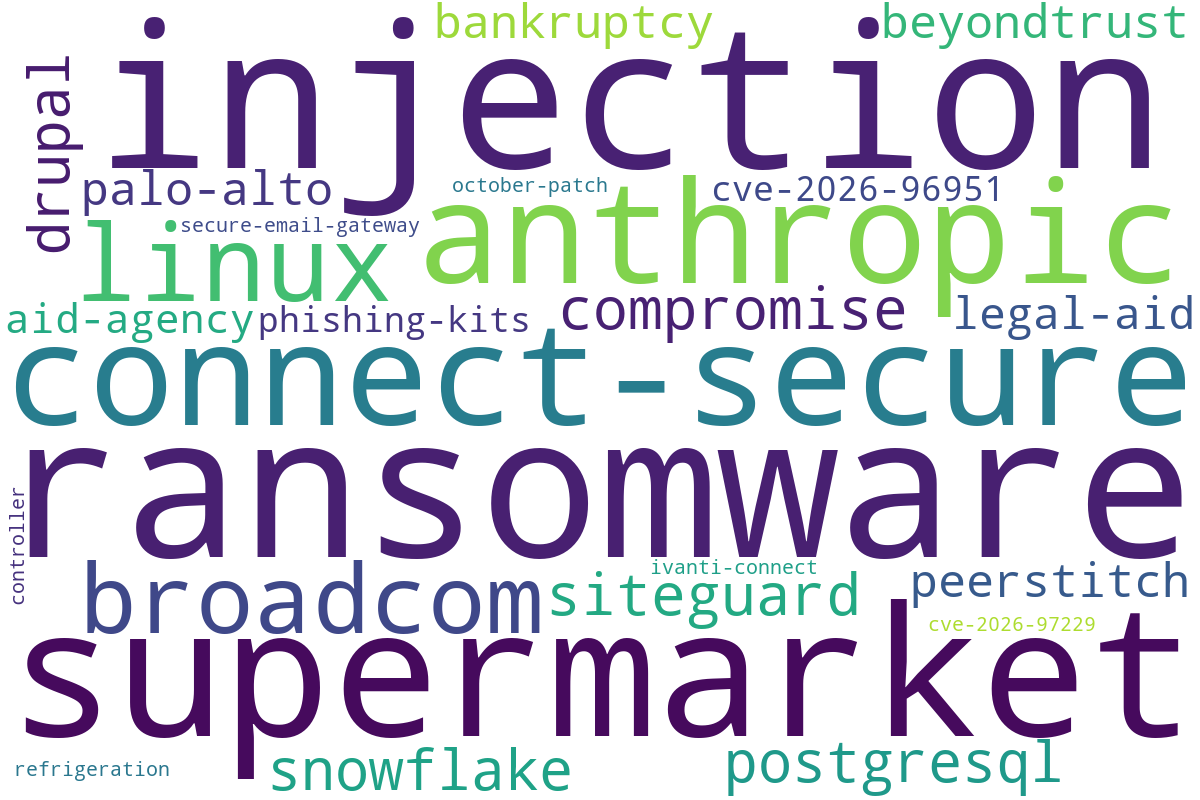
Weekly Coverage
Developments
Danfoss Refrigeration Attack Ledger Hardware Implant Connectwise Cloud Backup Breach Beyondtrust Zero-Day
Vulnerabilities
CVE-2026-102764Remote Support (Critical)CVE-2026-104935Connect_Secure 25.1.1.2 (High)CVE-2026-76519Cisco Secure Email 14.0.0-698 (Critical)CVE-2026-106931Siteguard Server Edition For Apache Httpd Ver2.20 (High)
Threat Groups
Scattered SpiderScattered Spider is a native Englishspeaking cybercriminal group active since at least 2022. The group initially targeted customer relationship management (CRM) providers, business process outsourcing (BPO) firms, and telecommunications and technology companies before expanding in 2023 to gaming, hospitality, retail, managed service provider (MSP), manufacturing, and financial sectors. Scattered Spider relies heavily on social engineering, including impersonating IT and helpdesk staff, to gain initial access, bypass multifactor authentication (MFA), and compromise enterprise networks. The group has adapted its tooling to evade endpoint detection and response (EDR) defenses and used ransomware for financial gain. Scattered Spider had expanded into hybrid cloud and identity environments, using helpdesk impersonation and MFA bypass to obtain administrator access in Okta, AWS, and Office 365.PlayPlay is a ransomware group that has been active since at least 2022 deploying Playcrypt ransomware against the business, government, critical infrastructure, healthcare, and media sectors in North America, South America, and Europe. Play actors employ a doubleextortion model, encrypting systems after exfiltrating data, and are presumed by security researchers to operate as a closed group.APT28APT28 is a threat group that has been attributed to Russia's General Staff Main Intelligence Directorate (GRU) 85th Main Special Service Center (GTsSS) military unit 26165. This group has been active since at least 2004. APT28 reportedly compromised the Hillary Clinton campaign, the Democratic National Committee, and the Democratic Congressional Campaign Committee in 2016 in an attempt to interfere with the U. S. presidential election. In 2018, the US indicted five GRU Unit 26165 officers associated with APT28 for cyber operations (including closeaccess operations) conducted between 2014 and 2018 against the World AntiDoping Agency (WADA), the US AntiDoping Agency, a US nuclear facility, the Organization for the Prohibition of Chemical Weapons (OPCW), the Spiez Swiss Chemicals Laboratory, and other organizations. Some of these were conducted with the assistance of GRU Unit 74455, which is also referred to as Sandworm Team.AkiraAkira is a ransomware variant and ransomware deployment entity active since at least March 2023. Akira uses compromised credentials to access singlefactor external access mechanisms such as VPNs for initial access, then various publiclyavailable tools and techniques for lateral movement. Akira operations are associated with "double extortion" ransomware activity, where data is exfiltrated from victim environments prior to encryption, with threats to publish files if a ransom is not paid. Technical analysis of Akira ransomware indicates variants capable of targeting Windows or VMWare ESXi hypervisors and multiple overlaps with Conti ransomware.LAPSUS$LAPSUS$ is cyber criminal threat group that has been active since at least mid2021. LAPSUS$ specializes in largescale social engineering and extortion operations, including destructive attacks without the use of ransomware. The group has targeted organizations globally, including in the government, manufacturing, higher education, energy, healthcare, technology, telecommunications, and media sectors.CHROMIUMEarth Lusca is a suspected Chinabased cyber espionage group that has been active since at least April 2019. Earth Lusca has targeted organizations in Australia, China, Hong Kong, Mongolia, Nepal, the Philippines, Taiwan, Thailand, Vietnam, the United Arab Emirates, Nigeria, Germany, France, and the United States. Targets included government institutions, news media outlets, gambling companies, educational institutions, COVID19 research organizations, telecommunications companies, religious movements banned in China, and cryptocurrency trading platforms; security researchers assess some Earth Lusca operations may be financially motivated. Earth Lusca has used malware commonly used by other Chinese threat groups, including APT41 and the Winnti Group cluster, however security researchers assess Earth Lusca's techniques and infrastructure are separate.Salt TyphoonSalt Typhoon is a People's Republic of China (PRC) statebacked actor that has been active since at least 2019 and responsible for numerous compromises of network infrastructure at major U. S. telecommunication and internet service providers (ISP).MuddyWaterMuddyWater is a cyber espionage group assessed to be a subordinate element within Iran's Ministry of Intelligence and Security (MOIS). Since at least 2017, MuddyWater has targeted a range of government and private organizations across sectors, including telecommunications, local government, defense, and oil and natural gas organizations, in the Middle East, Asia, Africa, Europe, and North America.Lazarus GroupLazarus Group is a North Korean statesponsored cyber threat group attributed to the Reconnaissance General Bureau (RGB). Lazarus Group has been active since at least 2009 and is reportedly responsible for the November 2014 destructive wiper attack on Sony Pictures Entertainment, identified by Novetta as part of Operation Blockbuster. Malware used by Lazarus Group correlates to other reported campaigns, including Operation Flame, Operation 1Mission, Operation Troy, DarkSeoul, and Ten Days of Rain. North Korea’s cyber operations have shown a consistent pattern of adaptation, forming and reorganizing units as national priorities shift. These units frequently share personnel, infrastructure, malware, and tradecraft, making it difficult to attribute specific operations with high confidence. Public reporting often uses “Lazarus Group” as an umbrella term for multiple North Korean cyber operators conducting espionage, destructive attacks, and financially motivated campaigns.Contagious InterviewContagious Interview is a North Korea–aligned threat group active since 2023. The group conducts both cyberespionage and financially motivated operations, including the theft of cryptocurrency and user credentials. Contagious Interview targets Windows, Linux, and macOS systems, with a particular focus on individuals engaged in software development and cryptocurrencyrelated activities.