Curated cybersecurity briefings on active threats, vulnerabilities, and emerging risks
Weekly Cybersecurity Briefing (16 November – 22 November 2026)
This briefing covers 366 reports published from 16 November to 22 November 2026.
At a Glance
- A suspected China-linked group used autonomous AI agents to discover and exploit a MONAI Label zero-day, gaining root access to a university server.
- Attackers exploited a VMware vCenter authentication bypass for more than two months, stealing SSO signing keys and creating administrator accounts.
- A compromised Optimizely platform delivered malicious JavaScript to websites operated by 178 organisations, stealing payment details and targeting mobile devices.
- Malicious versions of Microsoft's Agent Framework package on PyPI installed credential-stealing code whenever Python launched, harvesting cloud and CI/CD tokens.
- Ukrainian police and the FBI dismantled a ransomware operation linked to former Conti members, with at least 28 companies reportedly paying over $40 million.
Editorial Analysis
The VMware vCenter vulnerability was the week's most significant infrastructure concern. CVE-2026-123890 was exploited as a zero-day, exposing organisations running the virtualisation management platform before a patch was available. Its significance stems from vCenter's central role in managing virtualised environments: compromising this layer can have consequences across multiple virtual machines and applications. The incident also highlighted the risk posed by vulnerabilities in centralised infrastructure, particularly when exploitation is already under way before disclosure.
AI-related attacks took several forms during the week. Reporting on the ARTEX and Cairn campaigns, including activity involving MONAI Label, showed attackers using AI-assisted tools to target systems and workflows associated with AI development and deployment. The incidents are distinct, but each highlights the security of the infrastructure supporting AI applications, including their interfaces and underlying services. As these tools become embedded in operational environments, vulnerabilities in the surrounding systems can provide access well beyond the AI applications themselves.
Software distribution and trusted web infrastructure were also prominent targets. The compromise of Optimizely's JavaScript delivery mechanism affected a channel used to serve code to websites, while malicious releases of Microsoft's Agent Framework on PyPI introduced harmful packages into a legitimate developer ecosystem. The two incidents involved different distribution mechanisms, but both exploited trust in established software channels. The Optimizely compromise was particularly significant because access to the service's delivery infrastructure allowed malicious code to reach downstream websites without attackers having to breach each site individually.
The arrest of suspects linked to a Ukrainian ransomware operation provided a further development in efforts to pursue cybercriminals beyond their online infrastructure. The arrests do not establish that the wider operation has been dismantled, but they represent a tangible step in the investigation of the individuals behind it.
Highlights of the Week
VMware vCenter Zero-Day Exploited to Create Rogue Administrator Accounts
A suspected China-linked group exploited CVE-2026-123890 in VMware vCenter from at least early September, obtaining administrator sessions without passwords through a flaw in VMware Directory Service. The attackers extracted directory data and SAML signing keys, created rogue SSO administrators and moved on to ESXi hosts and virtual machines. Broadcom released fixes on 19 November.
Optimizely Compromise Injects Malicious JavaScript into 178 Organisations' Websites
Attackers exploited Optimizely's Experimentation platform to modify customer JavaScript snippets, affecting 188 snippets belonging to 178 organisations. The injected code skimmed payment card details, replaced cryptocurrency wallet addresses and delivered Coruna and DarkSword exploit kits to some Apple mobile devices. Optimizely says it fixed the vulnerability and removed the malicious code.
AI Agents Used in Credential Theft and Zero-Day Intrusions
The ARTEX framework was used in campaigns that stole AI provider keys, searched for further credentials and attempted cryptocurrency exchange identity checks using deepfakes. Separately, Cairn agents exploited a previously unknown MONAI Label vulnerability to gain root access to a university server. Amazon attributes the activity to Chinese-nexus groups with moderate confidence.
Malicious Microsoft Agent Framework Releases Steal Cloud Credentials
Two compromised versions of Microsoft's Agent Framework package, 1.26.1 and 1.26.2, were published to PyPI on 17 November. A malicious .pth startup file executed whenever Python launched, collecting environment variables, credential files and cloud identity tokens without requiring the package to be imported. PyPI quarantined both releases.
Ukrainian Police and FBI Target Ransomware Operation Linked to Former Conti Members
Ukrainian police and the FBI conducted 66 searches across Kyiv and 11 regions, targeting a group of at least 27 people linked to ransomware operations. Investigators say the attackers used AI-generated voice calls impersonating IT support to obtain credentials or install remote-access software before stealing data and deploying ransomware. At least 28 companies reportedly paid more than $40.5 million.
Threats
Com-Affiliated Groups Use Vishing to Steal Cloud Data
Groups including Bling Libra, Vortex and Cinder impersonated IT support staff to direct employees to adversary-in-the-middle phishing pages that captured credentials and MFA approvals. Attackers enrolled their own MFA devices, accessed Microsoft 365 data and sent extortion messages through Teams or email. Healthcare became the most targeted sector in September.
Retadup USB Worm Returns with CoffeeLoader Malware
A revived Retadup worm is distributing a CoffeeLoader variant after its command servers were re-registered following a 2019 law-enforcement takedown. The malware uses a patched 7-Zip library and a packer that decrypts its payload on the GPU through OpenGL. Infection attempts were blocked on around 15,000 systems this year.
Infrastructure & Exploits
Java4Shell Affects OpenJDK Base64 Decoder on AVX-512 Systems
CVE-2026-114938 is an integer underflow in OpenJDK's optimised Base64 decoder that can cause a 62-byte heap overflow on supported x86-64 processors with AVX-512 VBMI. Researchers demonstrated unauthenticated code execution paths in products including Jenkins, Jira, Confluence and Keycloak. Oracle released fixes for affected OpenJDK versions, with no in-the-wild exploitation reported.
Critical NGINX HTTP/2 Flaws Allow Unauthenticated Code Execution
F5 patched two critical HTTP/2 vulnerabilities, CVE-2026-123633 and CVE-2026-123007, which can allow unauthenticated remote code execution. The older integer-underflow flaw dates to NGINX 1.9.5, and public proof-of-concept code is available. Fixes were released in NGINX Open Source versions 1.30.7 and 1.31.9.
Danfoss AK-SM800A Controllers Affected by Six Remote Code Execution Flaws
Researchers disclosed six pre-authentication stack-based buffer overflows affecting Danfoss AK-SM800A controllers running firmware up to and including 5.3.2. The affected process runs as root, and one flaw bypasses strict session control. Firmware 5.4.0 does not fix the vulnerabilities, and CVE identifiers were pending at disclosure.
Tools & Techniques
Fake Banking Apps Use SMS Theft and Call Forwarding
A malware-as-a-service operation targeting Indian banks offered fraudsters a panel with 50 tenant accounts, 34 of them paid. Fake Google Play pages collected card details before delivering Android malware that disabled Play Protect, stole SMS messages containing one-time passwords and redirected bank verification calls to attackers.
Typosquatters Register Lookalike Domains Within One Working Day
Attackers registered 25 one-letter lookalikes of newly registered campaign domains belonging to companies including CarMax, McDonald's and Sanofi. Most substituted the genuine domain by removing a plural "s". The lookalike sites hosted parked pages, deceptive search portals and brand-themed blogs that directed visitors to scam websites through advertising links.
Policy & Legal
Project Zero Moves Towards 30-Day Vulnerability Disclosure
Google Project Zero replaced its "90 + 30" disclosure policy with "Full X", setting disclosure deadlines at 90 days initially, 60 days from 2 February 2027 and 30 days from 3 January 2028. The revised policy removes grace periods and variant handling, with exceptions for actively exploited, already public or vendor-requested disclosures.
Anthropic Shortens Coordinated Disclosure Timelines
Anthropic is reducing its coordinated vulnerability disclosure window from 90 to 30 days for high- and critical-severity flaws. Reports made from 1 January 2027 will have a 45-day window for other issues. Escalation to an external coordinator will begin after 15 days without a maintainer response, rather than 30.
US Agencies Establish Threat Disruption Centre to Target Scams
The US Department of Justice and Department of Homeland Security established a Threat Disruption Center to coordinate victim reports, criminal-network intelligence and cooperation with private companies. The centre has moved to take down more than 1,600 scam websites, added over 6,600 scam-linked cryptocurrency wallet addresses to a screening network and identified 101 fraud networks.
Alleged 8-Digits Team Member Extradited to the United States
Roman Khlynovskiy, a Kazakh national accused of involvement with the 8-Digits Team ransomware group, appeared in a Tennessee federal court after extradition from Italy. Prosecutors allege the group targeted hospitals and schools in at least six US states, claimed more than 70 million health records and issued ransom demands exceeding $500 million.
Weekly Topic Distribution
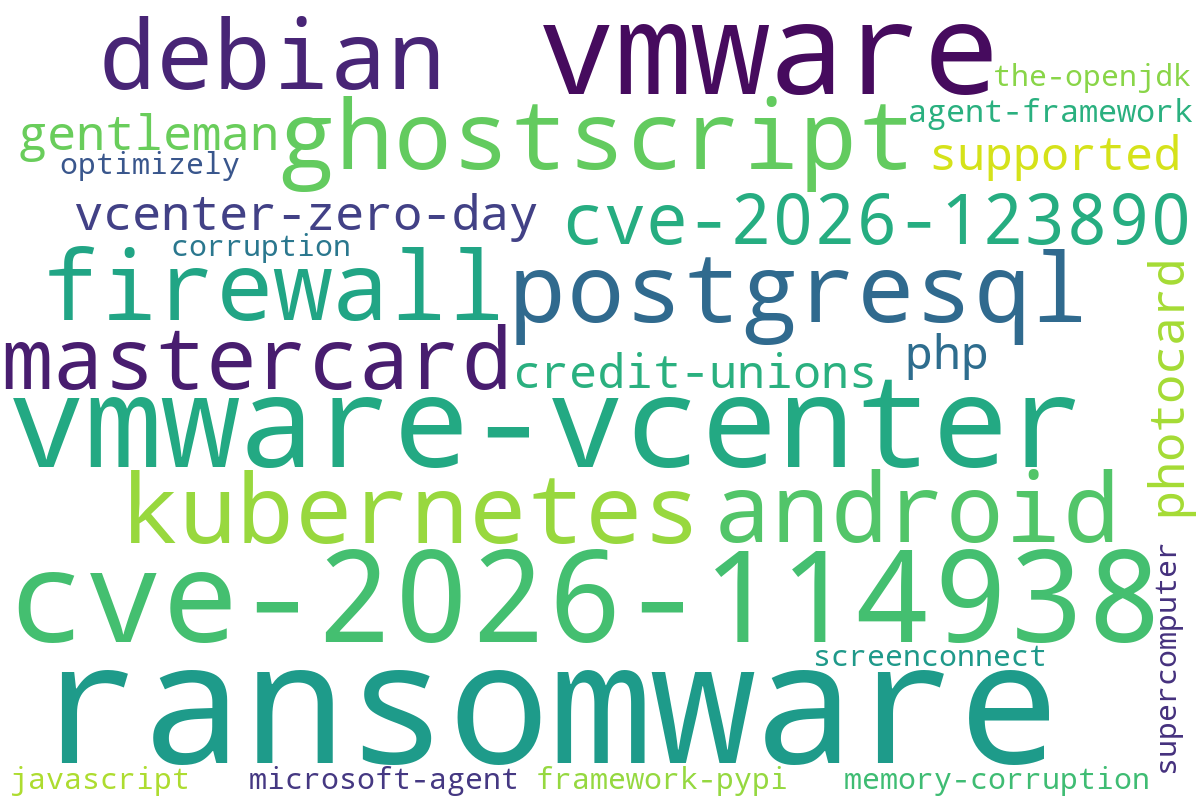
Weekly Coverage
Developments
Artex Ai Campaigns Vmware Vcenter Zero-Day Optimizely Compromise Agent Framework Malware
Vulnerabilities
CVE-2026-123890Vmware Vcenter 9.1.X (Critical)CVE-2026-114938Oracle Java Se 8U511B33-Perf (High)CVE-2026-123633Nginx Open Source 1.31.0 (High)CVE-2026-123007Nginx Plus 37.1.0 (High)
Threat Groups
Scattered SpiderScattered Spider is a native Englishspeaking cybercriminal group active since at least 2022. The group initially targeted customer relationship management (CRM) providers, business process outsourcing (BPO) firms, and telecommunications and technology companies before expanding in 2023 to gaming, hospitality, retail, managed service provider (MSP), manufacturing, and financial sectors. Scattered Spider relies heavily on social engineering, including impersonating IT and helpdesk staff, to gain initial access, bypass multifactor authentication (MFA), and compromise enterprise networks. The group has adapted its tooling to evade endpoint detection and response (EDR) defenses and used ransomware for financial gain. Scattered Spider had expanded into hybrid cloud and identity environments, using helpdesk impersonation and MFA bypass to obtain administrator access in Okta, AWS, and Office 365.PlayPlay is a ransomware group that has been active since at least 2022 deploying Playcrypt ransomware against the business, government, critical infrastructure, healthcare, and media sectors in North America, South America, and Europe. Play actors employ a doubleextortion model, encrypting systems after exfiltrating data, and are presumed by security researchers to operate as a closed group.LAPSUS$LAPSUS$ is cyber criminal threat group that has been active since at least mid2021. LAPSUS$ specializes in largescale social engineering and extortion operations, including destructive attacks without the use of ransomware. The group has targeted organizations globally, including in the government, manufacturing, higher education, energy, healthcare, technology, telecommunications, and media sectors.AkiraAkira is a ransomware variant and ransomware deployment entity active since at least March 2023. Akira uses compromised credentials to access singlefactor external access mechanisms such as VPNs for initial access, then various publiclyavailable tools and techniques for lateral movement. Akira operations are associated with "double extortion" ransomware activity, where data is exfiltrated from victim environments prior to encryption, with threats to publish files if a ransom is not paid. Technical analysis of Akira ransomware indicates variants capable of targeting Windows or VMWare ESXi hypervisors and multiple overlaps with Conti ransomware.APT28APT28 is a threat group that has been attributed to Russia's General Staff Main Intelligence Directorate (GRU) 85th Main Special Service Center (GTsSS) military unit 26165. This group has been active since at least 2004. APT28 reportedly compromised the Hillary Clinton campaign, the Democratic National Committee, and the Democratic Congressional Campaign Committee in 2016 in an attempt to interfere with the U. S. presidential election. In 2018, the US indicted five GRU Unit 26165 officers associated with APT28 for cyber operations (including closeaccess operations) conducted between 2014 and 2018 against the World AntiDoping Agency (WADA), the US AntiDoping Agency, a US nuclear facility, the Organization for the Prohibition of Chemical Weapons (OPCW), the Spiez Swiss Chemicals Laboratory, and other organizations. Some of these were conducted with the assistance of GRU Unit 74455, which is also referred to as Sandworm Team.CHROMIUMEarth Lusca is a suspected Chinabased cyber espionage group that has been active since at least April 2019. Earth Lusca has targeted organizations in Australia, China, Hong Kong, Mongolia, Nepal, the Philippines, Taiwan, Thailand, Vietnam, the United Arab Emirates, Nigeria, Germany, France, and the United States. Targets included government institutions, news media outlets, gambling companies, educational institutions, COVID19 research organizations, telecommunications companies, religious movements banned in China, and cryptocurrency trading platforms; security researchers assess some Earth Lusca operations may be financially motivated. Earth Lusca has used malware commonly used by other Chinese threat groups, including APT41 and the Winnti Group cluster, however security researchers assess Earth Lusca's techniques and infrastructure are separate.MuddyWaterMuddyWater is a cyber espionage group assessed to be a subordinate element within Iran's Ministry of Intelligence and Security (MOIS). Since at least 2017, MuddyWater has targeted a range of government and private organizations across sectors, including telecommunications, local government, defense, and oil and natural gas organizations, in the Middle East, Asia, Africa, Europe, and North America.Lazarus GroupLazarus Group is a North Korean statesponsored cyber threat group attributed to the Reconnaissance General Bureau (RGB). Lazarus Group has been active since at least 2009 and is reportedly responsible for the November 2014 destructive wiper attack on Sony Pictures Entertainment, identified by Novetta as part of Operation Blockbuster. Malware used by Lazarus Group correlates to other reported campaigns, including Operation Flame, Operation 1Mission, Operation Troy, DarkSeoul, and Ten Days of Rain. North Korea’s cyber operations have shown a consistent pattern of adaptation, forming and reorganizing units as national priorities shift. These units frequently share personnel, infrastructure, malware, and tradecraft, making it difficult to attribute specific operations with high confidence. Public reporting often uses “Lazarus Group” as an umbrella term for multiple North Korean cyber operators conducting espionage, destructive attacks, and financially motivated campaigns.Salt TyphoonSalt Typhoon is a People's Republic of China (PRC) statebacked actor that has been active since at least 2019 and responsible for numerous compromises of network infrastructure at major U. S. telecommunication and internet service providers (ISP).Contagious InterviewContagious Interview is a North Korea–aligned threat group active since 2023. The group conducts both cyberespionage and financially motivated operations, including the theft of cryptocurrency and user credentials. Contagious Interview targets Windows, Linux, and macOS systems, with a particular focus on individuals engaged in software development and cryptocurrencyrelated activities.