Curated cybersecurity briefings on active threats, vulnerabilities, and emerging risks
Weekly Cybersecurity Briefing (9 November – 15 November 2026)
Published: Loading…
This briefing covers 343 reports published from 9 November to 15 November 2026.
At a Glance
- France attributed the October refrigeration-controller attacks at about 700 retail sites, which caused at least 15 fires, to an Iranian IRGC cyber unit.
- Attackers exploited Check Point gateways with PHP2Shell and a root privilege-escalation flaw, deploying backdoors and a wiper against a VMware ESXi host.
- Compromised ScreenConnect environments at managed service providers pushed rogue clients and the SCKit toolkit to at least 288 hosts across 48 organisations.
- The FBI and SentinelOne reported that the open-source AI framework ARTEX has been used in espionage and criminal intrusions since late August.
- Breaches at Fireworks AI, Cursor and Railway exposed credentials, coding agent traces and billing data, and Cursor's marketplace cache served a malicious extension.
Editorial Analysis
The Check Point gateway intrusions centred on a flaw that was easy to underrate. CVE-2026-123039 scored 7.8 because it is a local vulnerability: the DynamicCLI process creates a world-writable socket at /tmp/dynamic_socket and executes any command it receives as root. Attackers obtained initial code execution through PHP2Shell in the Mobile Access portal, then exploited the flaw to place webshells and the TSGA and TSProxy backdoors. They moved over SSH to a VMware ESXi host and ran the destroy_v6 wiper. Exploitation began on 30 October, about a week after a fix became available. It initially affected Israeli organisations, some destructively, while a wider wave on 2 November showed no destructive activity. Check Point says it observed exploitation against a couple of dozen customers, and CISA has since added the vulnerability to its KEV catalogue. Attribution remains unresolved. TSGA and TSProxy are PhiliKit variants previously linked by ESET to UNC5221, and the scanning hours align with Chinese working time. The wiper, Hebrew ransom note and Dream Security branding do not fit that profile. Check Point has not ruled out an initial access broker, a false flag or a smokescreen.
The ScreenConnect campaign has two competing accounts of how attackers gained access, and the sources have yet to agree. Huntress traced the activity to the RMM+ extension, whose versions 1.0.31 and 1.0.32 accepted a blank access key when none had been configured. It counted at least 288 hosts across 48 organisations affected within 90 minutes. Blackpoint says the recovered SCKit toolkit exploits CVE-2026-84869, a file-transfer vulnerability ConnectWise fixed in client version 26.6.5 in September. ConnectWise says that fix prevents the toolkit from spreading from endpoints to technicians, and Huntress has not observed that spread succeeding. ConnectWise's investigation into the initial entry method is ongoing. Microsoft's analysis highlights two practical details: updating the cloud console does not update technician machines, which receive the fix only through the client; and securing the legitimate console does not remove the second ScreenConnect client already installed on customer endpoints.
ARTEX was covered by four sources this week, including SentinelOne, the FBI and Datadog. Much of the reporting concerns activity after its developer withdrew the project. The repository was taken down on 8 October, but forks, archived copies and a commercial ARTEX PRO version remain available. More than 1,600 exposed consoles had been identified by early November. SentinelOne found campaigns costing between $145 and $1,500 in model time. Of the ten instances it analysed, three used American models. Guardrails triggered only on Opus 5.5, after which the operator switched to more permissive Chinese models. Figures for the ConnectWise activity vary by source. SentinelOne describes attempted sign-ins to more than 2,250 tenants through compromised ConnectWise applications, while the FBI cites a compromise that reached more than 2,250 downstream tenants. Huntress's earlier count of confirmed affected tenants was 162, with other reports citing 173.
Cursor's account of its breach sets out a clear chain of access. An access key issued to Fireworks was exposed and used to copy coding agent traces from a read-only storage bucket shared for model training. The traces came mostly from 2025 and from sessions outside Privacy Mode, with a small number containing unredacted credentials. Those credentials exposed API access for fewer than 0.01% of customers, allowing the attacker to reach archived non-production repositories and limited support data. On 29 October, a stolen credential was used to place malicious copies of the Claude Code extension on the cache serving Cursor's marketplace. The upstream Open VSX source never contained the malware, and up to 5,000 users may have received it over approximately 11 hours. Fireworks separately attributes its own breach to a third-party cloud provider hosting its R&D systems and links the activity to LLMJacking. Railway reported approximately $740,000 in fraudulent AI usage, while Notion confirmed that chat transcripts in a small number of workspaces had been exposed through Fireworks.
France's attribution of the October refrigeration attacks provides a firmer account of the incident. The C4 attributes the attacks on 11 and 12 October to Shahid Kaveh, a unit within the IRGC's electronic and cyber centre. It cites shared infrastructure, use of the FOFA scanning tool and Farsi-language traces in the attack infrastructure. The same infrastructure was used for reconnaissance against Schneider Electric equipment at small hydroelectric sites. France says it will respond using all available means, but has not specified what that will involve.
VulnCheck's seven-month review of Project Glasswing offers a critical assessment from a vulnerability-intelligence vendor. Anthropic has not commented in the material available. VulnCheck tracks 442 CVEs attributed to Anthropic, approximately 0.5% of those published this year, with two exploited in the wild. Anthropic's ledger lists 37,966 findings, of which 7,349 are public and 217 are marked fixed. The company's claimed 94.2% true-positive rate sits alongside 1,654 recorded duplicates. Curl has classified 19 of 34 published scanner reports as not representing vulnerabilities, confirmed six as low severity and is still assessing nine.
Highlights of the Week
France Blames Iran's IRGC for Supermarket Refrigeration Attacks
France's C4 attributed the 11 and 12 October attacks on refrigeration controllers at about 700 retail sites to Shahid Kaveh, a unit of Iran's IRGC electronic and cyber centre. Attackers raised defrost temperatures, causing major stock losses and at least 15 fires. The same infrastructure was used for reconnaissance against Schneider Electric equipment at small hydroelectric sites. France promised a response without specifying it.
Attackers Exploit Check Point Gateways to Deploy Backdoors and a Wiper
Attackers used PHP2Shell on Check Point Mobile Access portals, then gained root through CVE-2026-123039, a local flaw in the DynamicCLI interface. They installed the TSGA and TSProxy backdoors, pivoted over SSH to a VMware ESXi host and ran the destroy_v6 wiper. Activity began on 30 October against Israeli organisations; a wider wave on 2 November showed no destructive activity. Check Point observed exploitation against a couple of dozen customers.
ScreenConnect Campaign Installs Rogue Clients and SCKit Toolkit at MSPs
Attackers used cloud-hosted ScreenConnect instances at managed service providers to push rogue clients and the SCKit toolkit, affecting at least 288 hosts across 48 organisations within 90 minutes, according to Huntress. RMM+ extension versions 1.0.31 and 1.0.32 accepted a blank access key. Microsoft reports SCKit builds RelayTrap and steals .ASPXAUTH cookies; ConnectWise's investigation of the entry method continues.
ARTEX AI Penetration Framework Used in Espionage and Cybercrime
SentinelOne reports at least five actors have used the ARTEX framework since late August, including VAPOR PANDA, which targeted over 200 organisations in 14 countries. The FBI links it to the theft of data on about 67,000 people from South Korean financial institutions and a ConnectWise Cloud Backup compromise reaching over 2,250 tenants. The developer removed the repository on 8 October; forks and a commercial version remain available.
Fireworks AI and Cursor Breaches Expose Credentials, Billing Data and Model Files
Attackers reached Fireworks AI's development machines on 24 October through a compromised third-party cloud provider, accessing account and billing data and, for some customers, secrets, datasets and incomplete model weights. An exposed Fireworks-issued key let an attacker copy Cursor coding agent traces. On 29 October, malicious Claude Code extension copies reached Cursor's marketplace cache, with up to 5,000 users affected. Railway reported about $740,000 in fraudulent AI usage.
Threats
Turla Cereal Toolset Turns Exchange Servers Into Command Hubs
ESET documented Turla's Cereal toolset, which compromised Exchange servers at government bodies in Kazakhstan and Romania. The CerealNeuron backdoor listens for encrypted requests disguised as Exchange traffic, and CerealBox hijacks transport agents to copy emails, including NATO and EU correspondence in Romania.
Stolen GitHub Tokens Push Credential Stealer to Thousands of Repositories
Attackers using stolen GitHub tokens pushed malicious commits into more than 8,000 repositories, adding workflow code or npm postinstall hooks that steal secrets and create AWS and Azure access designed to survive rotation. Commits are reverted within about a minute, and poisoned versions reached one Packagist package and two Go modules.
FBI Disrupts North Korean FaceStealer Crypto Theft Scheme
The FBI and DOJ disrupted FaceStealer infrastructure that the bureau credits with more than $400 million in cryptocurrency theft over 18 months. Investigators seized over 900 victim webcam videos. The FBI attributes the activity to a North Korean group tracked as Sapphire Sleet and BlueNoroff, among other names.
Infrastructure & Exploits
Microsoft Patches Record 1,235 Flaws, Including Exploited Outlook Zero-Day
Microsoft's November Patch Tuesday addressed 1,235 vulnerabilities, 66 of them Critical. An actively exploited Outlook spoofing zero-day lets a crafted message make Outlook connect to an attacker-controlled location without the usual warning, potentially exposing the user's NTLM hash.
Xen Orchestra Authentication Bypass Exploited for Admin Access
Vates disclosed VSA-2026-062, where a crafted empty-object login token authenticates as the first stored token's owner. Attackers can gain admin access, run code on managed pools and take over XCP-ng nodes as root. Exploitation is active, and fixes are in versions 6.10.1 and 6.9.2.
Apache HTTP Server HTTP/2 Flaw Gets Public Proof of Concept
CVE-2026-119618 is a critical race condition in mod_http2 affecting Apache HTTP Server 2.4.55 through 2.4.70, fixed in 2.4.71. A third-party proof of concept published on 12 November reproduces heap corruption but not code execution, and no in-the-wild exploitation has been confirmed.
Tools & Techniques
Attackers Abuse GSocket Relay Tool to Keep Access After Patching
Threat actors deploy the open source GSocket tool on compromised Linux web servers, connecting outbound to a shared public relay network with no attacker-owned IP or domain. Devices with GSocket-related detections rose 356.2% between March and August 2026.
Editing Fewer Than Ten Neurons Can Backdoor AI Agent Models
Microsoft researchers showed that editing fewer than ten neurons in an open-weight model plants a backdoor without retraining. On Nemotron-Terminal-8B, seven edited neurons produced the attacker's command in at least 98.8% of triggered sessions; the attacker needs write access to the weights.
Policy & Legal
Europol Dismantles Gootloader, CastleRAT and StealC Infrastructure
Europol and partners seized 235 servers and 257 domains used to distribute Gootloader, CastleRAT and StealC. Authorities identified more than 6 million stolen credentials and remediated 681 Gootloader-infected websites, as part of Operation Endgame.
Ukrainian Police Dismantle Call Centres Defrauding German Investors of €4.3 Million
Ukrainian and German authorities dismantled call centres that posed as brokers and persuaded 135 German victims to invest through fake trading platforms, with losses above €4.3 million. Four members were detained, and the suspects face up to 12 years in prison.
Weekly Topic Distribution
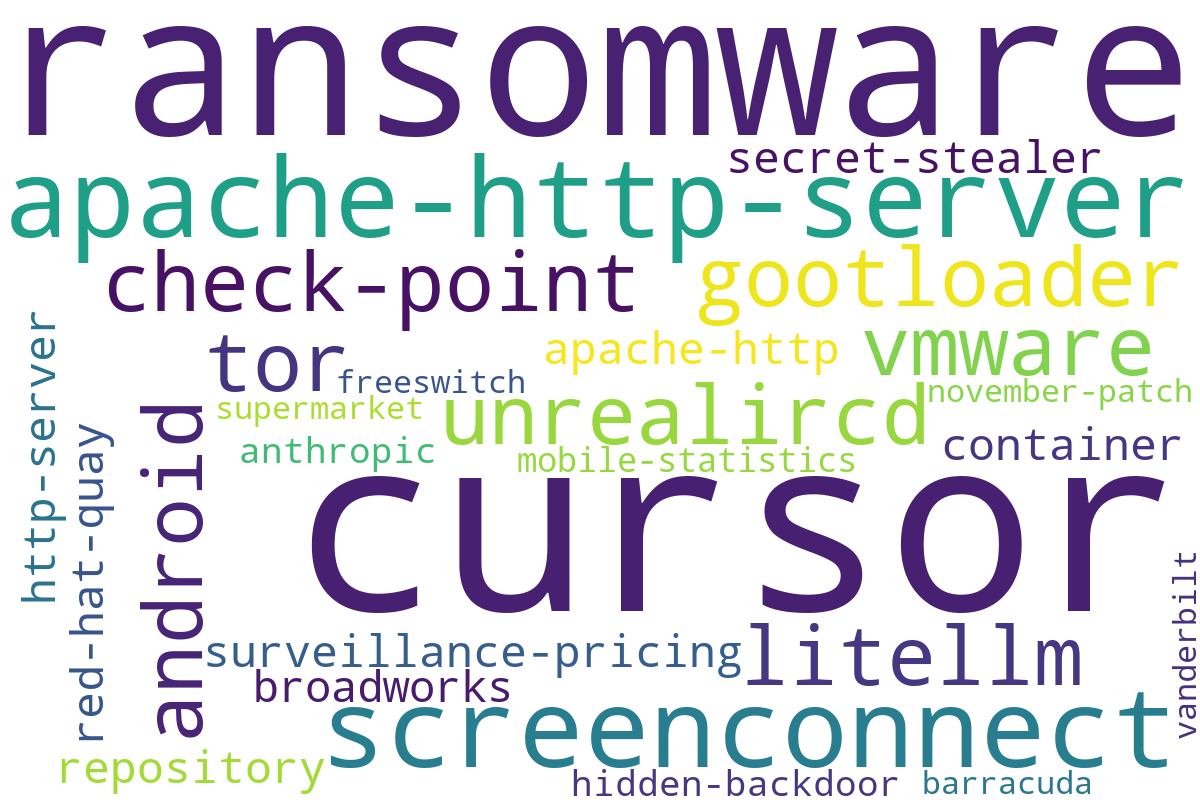
Weekly Coverage
Developments
Irgc Refrigeration Attacks Check Point Gateway Exploitation Screenconnect Sckit Campaign Artex Ai Framework
Vulnerabilities
CVE-2026-123039Quantum Security Gateway R82.10 With Jumbo Hotfix Take 50 Or Below (High)CVE-2026-84869Screenconnect All Versions Prior To 26.6.5CVE-2026-119618Apache Http Server 2.4.55
Threat Groups
Scattered SpiderScattered Spider is a native Englishspeaking cybercriminal group active since at least 2022. The group initially targeted customer relationship management (CRM) providers, business process outsourcing (BPO) firms, and telecommunications and technology companies before expanding in 2023 to gaming, hospitality, retail, managed service provider (MSP), manufacturing, and financial sectors. Scattered Spider relies heavily on social engineering, including impersonating IT and helpdesk staff, to gain initial access, bypass multifactor authentication (MFA), and compromise enterprise networks. The group has adapted its tooling to evade endpoint detection and response (EDR) defenses and used ransomware for financial gain. Scattered Spider had expanded into hybrid cloud and identity environments, using helpdesk impersonation and MFA bypass to obtain administrator access in Okta, AWS, and Office 365.PlayPlay is a ransomware group that has been active since at least 2022 deploying Playcrypt ransomware against the business, government, critical infrastructure, healthcare, and media sectors in North America, South America, and Europe. Play actors employ a doubleextortion model, encrypting systems after exfiltrating data, and are presumed by security researchers to operate as a closed group.AkiraAkira is a ransomware variant and ransomware deployment entity active since at least March 2023. Akira uses compromised credentials to access singlefactor external access mechanisms such as VPNs for initial access, then various publiclyavailable tools and techniques for lateral movement. Akira operations are associated with "double extortion" ransomware activity, where data is exfiltrated from victim environments prior to encryption, with threats to publish files if a ransom is not paid. Technical analysis of Akira ransomware indicates variants capable of targeting Windows or VMWare ESXi hypervisors and multiple overlaps with Conti ransomware.LAPSUS$LAPSUS$ is cyber criminal threat group that has been active since at least mid2021. LAPSUS$ specializes in largescale social engineering and extortion operations, including destructive attacks without the use of ransomware. The group has targeted organizations globally, including in the government, manufacturing, higher education, energy, healthcare, technology, telecommunications, and media sectors.APT28APT28 is a threat group that has been attributed to Russia's General Staff Main Intelligence Directorate (GRU) 85th Main Special Service Center (GTsSS) military unit 26165. This group has been active since at least 2004. APT28 reportedly compromised the Hillary Clinton campaign, the Democratic National Committee, and the Democratic Congressional Campaign Committee in 2016 in an attempt to interfere with the U. S. presidential election. In 2018, the US indicted five GRU Unit 26165 officers associated with APT28 for cyber operations (including closeaccess operations) conducted between 2014 and 2018 against the World AntiDoping Agency (WADA), the US AntiDoping Agency, a US nuclear facility, the Organization for the Prohibition of Chemical Weapons (OPCW), the Spiez Swiss Chemicals Laboratory, and other organizations. Some of these were conducted with the assistance of GRU Unit 74455, which is also referred to as Sandworm Team.CHROMIUMEarth Lusca is a suspected Chinabased cyber espionage group that has been active since at least April 2019. Earth Lusca has targeted organizations in Australia, China, Hong Kong, Mongolia, Nepal, the Philippines, Taiwan, Thailand, Vietnam, the United Arab Emirates, Nigeria, Germany, France, and the United States. Targets included government institutions, news media outlets, gambling companies, educational institutions, COVID19 research organizations, telecommunications companies, religious movements banned in China, and cryptocurrency trading platforms; security researchers assess some Earth Lusca operations may be financially motivated. Earth Lusca has used malware commonly used by other Chinese threat groups, including APT41 and the Winnti Group cluster, however security researchers assess Earth Lusca's techniques and infrastructure are separate.Lazarus GroupLazarus Group is a North Korean statesponsored cyber threat group attributed to the Reconnaissance General Bureau (RGB). Lazarus Group has been active since at least 2009 and is reportedly responsible for the November 2014 destructive wiper attack on Sony Pictures Entertainment, identified by Novetta as part of Operation Blockbuster. Malware used by Lazarus Group correlates to other reported campaigns, including Operation Flame, Operation 1Mission, Operation Troy, DarkSeoul, and Ten Days of Rain. North Korea’s cyber operations have shown a consistent pattern of adaptation, forming and reorganizing units as national priorities shift. These units frequently share personnel, infrastructure, malware, and tradecraft, making it difficult to attribute specific operations with high confidence. Public reporting often uses “Lazarus Group” as an umbrella term for multiple North Korean cyber operators conducting espionage, destructive attacks, and financially motivated campaigns.Salt TyphoonSalt Typhoon is a People's Republic of China (PRC) statebacked actor that has been active since at least 2019 and responsible for numerous compromises of network infrastructure at major U. S. telecommunication and internet service providers (ISP).MuddyWaterMuddyWater is a cyber espionage group assessed to be a subordinate element within Iran's Ministry of Intelligence and Security (MOIS). Since at least 2017, MuddyWater has targeted a range of government and private organizations across sectors, including telecommunications, local government, defense, and oil and natural gas organizations, in the Middle East, Asia, Africa, Europe, and North America.Contagious InterviewContagious Interview is a North Korea–aligned threat group active since 2023. The group conducts both cyberespionage and financially motivated operations, including the theft of cryptocurrency and user credentials. Contagious Interview targets Windows, Linux, and macOS systems, with a particular focus on individuals engaged in software development and cryptocurrencyrelated activities.