CyberSecBrief

Curated cybersecurity briefings on active threats, vulnerabilities, and emerging risks


Weekly Cybersecurity Briefing (26 October – 1 November 2026)

Published: Loading…

This briefing covers 341 reports published from 26 October to 1 November 2026.

At a Glance

  • CISA added the PHP2Shell flaws CVE-2026-109618 and CVE-2026-109619 to its KEV catalogue, and attackers chained them with a Linux kernel bug to root 25 servers.
  • The Brotli decoder flaw CVE-2026-111497, known as Node2Shell, was added to CISA's KEV catalogue and prompted emergency patches across Node.js, PHP and Microsoft products.
  • The FBI attributed the record Binance theft of more than $6 billion to North Korea's TraderTraitor, which is converting stolen assets mainly into Ethereum.
  • A trojanized Claude Code extension on Cursor's marketplace planted SSH backdoors and reverse tunnels, reaching up to 5,000 users in 11 hours.
  • Cisco Talos detailed KeyDrift malware that steals encryption keys from Cisco SD-WAN controllers, with infrastructure overlapping Volt Typhoon's Silent Train network.

Editorial Analysis

PHP2Shell and Node2Shell both entered CISA’s Known Exploited Vulnerabilities catalogue this week. For Node2Shell, the main question is how many systems can actually be fixed. Qualys telemetry shows that only around 42,000 of approximately three million Node.js installations had been patched, while 1.7 million were running end-of-life versions that will not receive fixes. Two honeypot operators recorded exploitation attempts, one of which involved a broken exploit.

Several incidents exposed a gap between patching a product and updating the vulnerable component it actually uses. GitLab’s remediation for CVE-2026-97229 patches the Ruby bundled with GitLab’s own packages and images. Alpine Linux’s upgrade to GitLab 19.3.6 therefore left its instance vulnerable because its image used the system Ruby, and the issue was discovered on 26 October. Brotli creates a similar complication across ecosystems. The library is bundled in Node.js and PHP’s Windows builds, while vulnerable versions are also present in Python packages that advisory databases initially failed to map to CVE-2026-111497. Oracle addressed three PeopleSoft weaknesses under the single identifier CVE-2026-35273, prompting researchers to seek separate identifiers. In these cases a product’s version number or an apparently completed upgrade did not, on its own, establish whether the affected code had been updated.

The FBI formally attributed the Binance theft to North Korea’s TraderTraitor and published cryptocurrency addresses associated with the laundering operation. Talos assessed with high confidence that KeyDrift’s infrastructure overlapped with Volt Typhoon’s Silent Train network, while explicitly stopping short of attributing KeyDrift itself to Volt Typhoon. AI appeared in several incidents in different roles. The VOLTA infostealer used language models to rank victims by the value of their stolen data, Chainalysis disclosed an intrusion involving what it called “offensive agentic techniques”, and a trojanised Claude Code extension reached up to 5,000 Cursor users. These cases do not establish a single common method or threat actor.

Deep Dive: PHP2Shell, Two Weeks On

The first week of PHP2Shell reporting ended with conflicting evidence. Sophos confirmed one compromise that delivered the Potassium Mirai variant, while CrowdStrike found no exploitation in the wild or in its honeypots. WatchTowr found that much of the publicly available exploit code failed, and Amazon recorded an attempted attack on 17 October, before the vulnerability details became public.

The second week brought clearer evidence that the exploit chain could succeed, although its reliability remained uncertain. On 26 October, CISA added CVE-2026-109618 and CVE-2026-109619 to its Known Exploited Vulnerabilities catalogue, setting a 29 October remediation deadline for federal agencies without disclosing the exploitation evidence behind the decision. On 23 October, CISA had said it had not observed successful exploitation. Perplexity researcher Adel Karimi’s honeypots subsequently recorded 35 shell executions on 24 October from two IP addresses. The attacks used a four-stage request chain that leaked memory before executing a command. However, the test environment was deliberately favourable: a single-worker mod_php configuration running PHP 8.4.26. No second-stage payload was observed, and Wiz reported that none of the attempts it tracked succeeded. The results demonstrate that the chain can work under specific conditions, not how reliably it works across other deployments.

The strongest evidence of substantial intrusion came from attacks against firewalls. Dream reported that attackers scanned approximately 19,000 firewalls, fingerprinted around 5,000 and narrowed their targets to 240 devices in the US, Japan, Taiwan and South Korea. They obtained root access on 24 servers and later a 25th, chaining PHP2Shell with the Fragnesia Linux kernel vulnerability, which CISA had also urged federal agencies to patch. On a US government-affiliated firewall, the attackers tunnelled into the internal network, recovered a decrypted LDAP service-account password and began enumerating Active Directory. Unit 42 independently verified the attackers’ tooling and reported exploitation of internet-exposed PAN-OS management interfaces. Palo Alto Networks said approximately 0.02% of its installed base was affected and that its patches break the exploit chain. Unit 42 also retracted its 23 October update after it could not link a reported intrusion involving a European government to the vulnerabilities.

Important uncertainties remain. Dream could not recover the results of later attack stages, leaving it unclear whether password spraying, backdoor account creation or SAML key extraction succeeded. No threat actor has been named. Dream cited FOFA use, UTC+8 timestamps and Chinese-language prompts as indicators of a possible Chinese nexus, not conclusive attribution. The estimate of 22.6 million potentially exposed instances measures possible exposure, not confirmed vulnerability or compromise. Bitsight also reported a surge in scanning, but few reliable exploits. Separately, for CVE-2026-115560, PHP has published mitigations rather than a patch, and the available evidence here does not indicate exploitation.

Highlights of the Week

PHP2Shell Exploitation Confirmed as Attackers Root Firewalls

CISA added PHP2Shell flaws CVE-2026-109618 and CVE-2026-109619 to its Known Exploited Vulnerabilities catalogue on 26 October, after honeypots recorded 35 shell executions on 24 October. Dream reported that suspected Chinese attackers chained the flaws with the Fragnesia Linux kernel bug to root 25 servers, including PAN-OS firewalls. Unit 42 counts more than 22.6 million potentially exposed instances.

Brotli Node2Shell Flaw Exploited as Emergency Patches Spread

CVE-2026-111497, an out-of-bounds write in Google's Brotli decoder, was added to CISA's catalogue on 27 October after honeypots logged exploitation attempts. Microsoft issued out-of-band fixes for .NET, Visual Studio and PowerShell, and PHP rebuilt its Windows packages. Qualys telemetry shows about 42,000 of roughly three million Node.js installations patched, with 1.7 million on end-of-life versions.

FBI Attributes Record $6 Billion Binance Theft to North Korea

Binance reported that about $6.3 billion in assets was stolen, which it linked to a compromised DevOps engineer's laptop before reporting additional points of breach. The FBI attributed the theft to North Korea's TraderTraitor and said the actors are converting stolen assets mainly into Ethereum. Binance says it will cover all losses.

Trojanized Claude Code Extension on Cursor Marketplace Plants SSH Backdoor

A tampered Claude Code extension, versions 2.1.312 and 2.1.313, was served on Cursor's marketplace on 29 October, reaching up to 5,000 users in 11 hours. The loader adds an attacker's SSH key, opens a reverse tunnel and sets up persistence, though Cursor says errors blocked SSH access on most macOS and Windows hosts. Anthropic says it did not build or publish the package.

Threats

Attackers Abuse Microsoft Teams External Chat to Impersonate IT Support

More than 400 incidents involved attackers using Teams external chat, enabled by default, to pose as IT helpdesk staff, often after email bombing. Victims installed remote access tools such as Quick Assist, and payload execution followed in under 15 minutes.

Sources: Arctic Wolf

JFrog Finds 42 Hijacked GitHub Repositories Armed in testmetest npm Campaign

The 42 repositories belong to 11 legitimate owners and contain hooks for AI coding assistants and IDEs. Their payload wrappers decode to a hidden CI publisher that uses stolen tokens to publish malicious npm releases.

Cyberattack Disrupts University of New Mexico Health Sciences Center

The centre detected a cybersecurity threat on 26 October that affected some end-user devices but not core systems. Ambulances were diverted for two hours, surgeries were suspended, and the BYOD ransomware group has reportedly claimed the attack.

Infrastructure & Exploits

Three Chained Flaws Behind Oracle PeopleSoft Zero-Day Enable Remote Code Execution

Oracle patched CVE-2026-35273 under one identifier although researchers reported three vulnerabilities. A server-side request forgery in the Integration Gateway reaches the Environment Management Hub, leading to remote code execution exploited by ShinyHunters.

Alpine Linux Rebuilds GitLab After Attempted CVE-2026-97229 Exploitation

An attacker crashed GitLab worker processes eight times on 20 and 21 October, and Alpine found no evidence of success but could not rule it out. GitLab's fix is a Ruby patch applied only in its own packages, which Alpine's image did not include.

Sources: Alpine Linux

16-Year-Old EDK2 Flaw Enables Pre-Boot Code Execution on Servers

CVE-2026-97631 is a buffer overflow in the PXE Base Code driver of TianoCore EDK II. An attacker on the local network can send an oversized ICMP error message during network boot to execute code before Secure Boot loads.

Sources: Ars Technica

Tools & Techniques

KeyDrift Malware Steals Encryption Keys From Cisco SD-WAN Controllers

UAT-11473 exploited CVE-2026-20127 to deploy KeyDrift, whose components extract keying material from decrypted control traffic inside vdaemon processes. Talos assesses with high confidence that the infrastructure overlaps with Volt Typhoon's Silent Train network.

Sources: Cisco Talos

VOLTA Infostealer Sends Stolen Data to an LLM to Rank Victims

The self-deleting Windows infostealer sends stolen credentials, sessions and wallet data to a language model through OpenRouter, which returns a ranking of the victim's assets. If the first model refuses, it falls back through two further models.

Sources: Cisco Talos

NetamLoader Malware Targets Custom Windows Build Used by Asian Governments

An unattributed actor delivered NetamLoader through a CAB archive in the Windows update folder, chaining XAML payloads that bypass AMSI and run inside dllhost.exe. Kaspersky identified one victim in Asia.

Sources: Kaspersky

Policy & Legal

Ukrainian Hacker Sentenced to 70 Months Over Nefilim and Hive Ransomware Attacks

Artem Stryzhak received 70 months as an affiliate of the Nefilim and Hive groups. Hive attacked about 1,500 victims between June 2021 and January 2023, causing more than $100 million in losses.

Authorities Seize Domain of Bulletproof Hosting Provider Virtualine

US authorities seized virtualine.net, a bulletproof hosting provider advertised on cybercrime forums. Court records say it knowingly hosted a forum selling sexually explicit images of minors and accepted unhosted bitcoin payments.

Syrian Electronic Army Hacker Jailed for 42 Months Over Attacks on Western Targets

Ahmad Umar Agha, known as "Th3Pr0", was sentenced in a Virginia federal court for hacking about 47 Western media outlets, non-profits and allied entities. He was first charged in 2014 and taken into US custody last year.

Sources: The Record

Weekly Topic Distribution

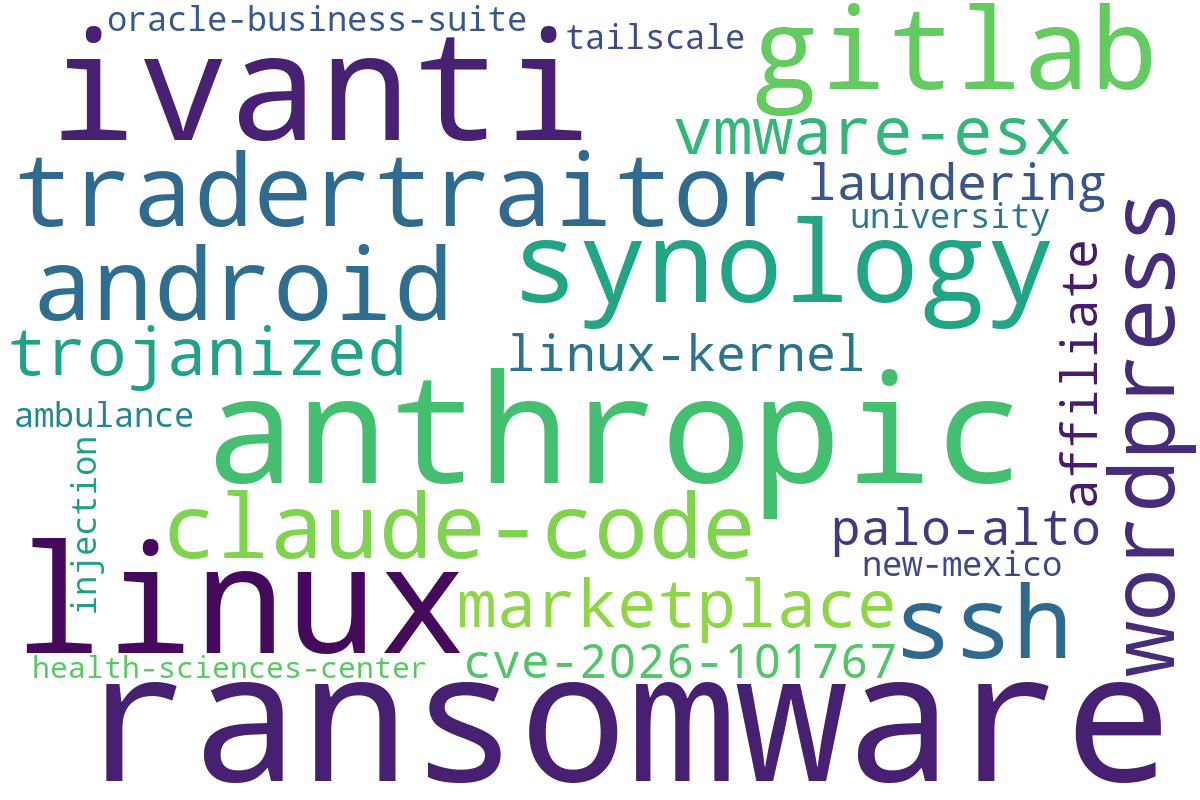
Weekly Coverage

Developments
Php2Shell Exploitation Node2Shell Brotli Flaw Binance Theft Attribution Claude Code Extension Backdoor
Vulnerabilities
CVE-2026-111497Brotli 1.0.3 (Critical)CVE-2026-109618Php 8.2.*CVE-2026-109619Php 8.2.*CVE-2026-35273Peoplesoft Enterprise Peopletools 8.61 (Critical)CVE-2026-97229Gitlab 19.2 (Critical)CVE-2026-97631Edk2 (Critical)CVE-2026-20127A Vulnerability In The Peering Authentication In Cisco Catalyst Sd-Wan Controller, Formerly Sd-Wan Vsmart, And Cisco Catalyst Sd-Wan Manager, Formerly Sd-Wan Vmanage, Could Allow An Unauthenticated, Remote Attacker To Bypass Authentication And Obtain Administrative Privileges On An Affected System. This Vulnerability Exists Because The Peering Authentication Mechanism In An Affected System Is Not Working Properly. An Attacker Could Exploit This Vulnerability By Sending Crafted Requests To An …
Threat Groups
Scattered SpiderScattered Spider is a native Englishspeaking cybercriminal group active since at least 2022. The group initially targeted customer relationship management (CRM) providers, business process outsourcing (BPO) firms, and telecommunications and technology companies before expanding in 2023 to gaming, hospitality, retail, managed service provider (MSP), manufacturing, and financial sectors. Scattered Spider relies heavily on social engineering, including impersonating IT and helpdesk staff, to gain initial access, bypass multifactor authentication (MFA), and compromise enterprise networks. The group has adapted its tooling to evade endpoint detection and response (EDR) defenses and used ransomware for financial gain. Scattered Spider had expanded into hybrid cloud and identity environments, using helpdesk impersonation and MFA bypass to obtain administrator access in Okta, AWS, and Office 365.PlayPlay is a ransomware group that has been active since at least 2022 deploying Playcrypt ransomware against the business, government, critical infrastructure, healthcare, and media sectors in North America, South America, and Europe. Play actors employ a doubleextortion model, encrypting systems after exfiltrating data, and are presumed by security researchers to operate as a closed group.AkiraAkira is a ransomware variant and ransomware deployment entity active since at least March 2023. Akira uses compromised credentials to access singlefactor external access mechanisms such as VPNs for initial access, then various publiclyavailable tools and techniques for lateral movement. Akira operations are associated with "double extortion" ransomware activity, where data is exfiltrated from victim environments prior to encryption, with threats to publish files if a ransom is not paid. Technical analysis of Akira ransomware indicates variants capable of targeting Windows or VMWare ESXi hypervisors and multiple overlaps with Conti ransomware.LAPSUS$LAPSUS$ is cyber criminal threat group that has been active since at least mid2021. LAPSUS$ specializes in largescale social engineering and extortion operations, including destructive attacks without the use of ransomware. The group has targeted organizations globally, including in the government, manufacturing, higher education, energy, healthcare, technology, telecommunications, and media sectors.APT28APT28 is a threat group that has been attributed to Russia's General Staff Main Intelligence Directorate (GRU) 85th Main Special Service Center (GTsSS) military unit 26165. This group has been active since at least 2004. APT28 reportedly compromised the Hillary Clinton campaign, the Democratic National Committee, and the Democratic Congressional Campaign Committee in 2016 in an attempt to interfere with the U. S. presidential election. In 2018, the US indicted five GRU Unit 26165 officers associated with APT28 for cyber operations (including closeaccess operations) conducted between 2014 and 2018 against the World AntiDoping Agency (WADA), the US AntiDoping Agency, a US nuclear facility, the Organization for the Prohibition of Chemical Weapons (OPCW), the Spiez Swiss Chemicals Laboratory, and other organizations. Some of these were conducted with the assistance of GRU Unit 74455, which is also referred to as Sandworm Team.CHROMIUMEarth Lusca is a suspected Chinabased cyber espionage group that has been active since at least April 2019. Earth Lusca has targeted organizations in Australia, China, Hong Kong, Mongolia, Nepal, the Philippines, Taiwan, Thailand, Vietnam, the United Arab Emirates, Nigeria, Germany, France, and the United States. Targets included government institutions, news media outlets, gambling companies, educational institutions, COVID19 research organizations, telecommunications companies, religious movements banned in China, and cryptocurrency trading platforms; security researchers assess some Earth Lusca operations may be financially motivated. Earth Lusca has used malware commonly used by other Chinese threat groups, including APT41 and the Winnti Group cluster, however security researchers assess Earth Lusca's techniques and infrastructure are separate.Lazarus GroupLazarus Group is a North Korean statesponsored cyber threat group attributed to the Reconnaissance General Bureau (RGB). Lazarus Group has been active since at least 2009 and is reportedly responsible for the November 2014 destructive wiper attack on Sony Pictures Entertainment, identified by Novetta as part of Operation Blockbuster. Malware used by Lazarus Group correlates to other reported campaigns, including Operation Flame, Operation 1Mission, Operation Troy, DarkSeoul, and Ten Days of Rain. North Korea’s cyber operations have shown a consistent pattern of adaptation, forming and reorganizing units as national priorities shift. These units frequently share personnel, infrastructure, malware, and tradecraft, making it difficult to attribute specific operations with high confidence. Public reporting often uses “Lazarus Group” as an umbrella term for multiple North Korean cyber operators conducting espionage, destructive attacks, and financially motivated campaigns.Salt TyphoonSalt Typhoon is a People's Republic of China (PRC) statebacked actor that has been active since at least 2019 and responsible for numerous compromises of network infrastructure at major U. S. telecommunication and internet service providers (ISP).MuddyWaterMuddyWater is a cyber espionage group assessed to be a subordinate element within Iran's Ministry of Intelligence and Security (MOIS). Since at least 2017, MuddyWater has targeted a range of government and private organizations across sectors, including telecommunications, local government, defense, and oil and natural gas organizations, in the Middle East, Asia, Africa, Europe, and North America.Contagious InterviewContagious Interview is a North Korea–aligned threat group active since 2023. The group conducts both cyberespionage and financially motivated operations, including the theft of cryptocurrency and user credentials. Contagious Interview targets Windows, Linux, and macOS systems, with a particular focus on individuals engaged in software development and cryptocurrencyrelated activities.