Curated cybersecurity briefings on active threats, vulnerabilities, and emerging risks
Weekly Cybersecurity Briefing (25 May – 31 May 2026)
Published: Loading…
This briefing covers 206 reports published from 25 May to 31 May 2026.
At a Glance
- Dutch authorities seized over 800 servers and dismantled a separate 17-million-device botnet in coordinated operations targeting Russian-linked infrastructure and proxy services.
- ShinyHunters breached both Canvas LMS, exposing data on 275 million users, and Carnival Corporation, affecting nearly six million customers via social engineering.
- The Lazarus Group deployed the memory-only RemotePE RAT using DPAPI encryption and ETW suppression against financial and cryptocurrency organisations.
- CrowdStrike coordinated a takedown of the Glassworm botnet, which spread through trojanised VSCode extensions, npm packages and compromised GitHub repositories.
- Multiple AI coding agents including Claude Code, Cursor and GitHub Copilot were found vulnerable to the SymJack symlink attack enabling remote code execution.
Summary
A week of large-scale infrastructure takedowns, high-impact data breaches and novel AI agent exploits.
- Dutch authorities arrested two individuals and seized over 800 servers linked to MIRhosting and WorkTitans, companies providing infrastructure to EU-sanctioned Russian entities connected to Stark Industries and attacks on Danish government organisations.
- A separate Dutch operation dismantled a 17-million-device botnet, seizing over 200 servers linked to proxy service Asocks and used in distributed denial-of-service and traffic proxying activity.
- ShinyHunters was linked to two major breaches: a Canvas LMS compromise exposing accounts tied to approximately 275 million users, and a Carnival Corporation breach affecting nearly six million individuals following a social engineering attack on an employee account.
- CrowdStrike coordinated the takedown of the Glassworm botnet, which targeted software developers through trojanised VSCode extensions, poisoned npm and Python packages, and compromised GitHub repositories using blockchain and peer-to-peer command-and-control.
- The Lazarus Group deployed the RemotePE memory-only RAT against financial and cryptocurrency organisations, using DPAPI encryption, ETW suppression and in-memory execution to evade forensic detection.
- Adversa AI disclosed SymJack, a symlink-based attack technique achieving remote code execution against Claude Code, Gemini CLI, Cursor, GitHub Copilot CLI, Grok Build and OpenAI Codex CLI through malicious repository configurations.
Highlights of the Week
Dutch Police Seize Servers Linked to Russian Cyber Operations
Dutch financial crime investigators arrested two men and seized more than 800 servers during raids targeting MIRhosting and WorkTitans, companies accused of providing infrastructure to EU-sanctioned Russian entities. Authorities said the firms operated network infrastructure linked to Stark Industries, a hosting provider associated with distributed denial-of-service attacks and cyber operations attributed to Russian intelligence groups. De Volkskrant reported that WorkTitans and MIRhosting networks were heavily used in pro-Russian attacks against Danish government organisations during Denmark's municipal elections in November 2025.
ShinyHunters Supply Chain Attack Hits Canvas LMS Platform
ShinyHunters accessed Canvas LMS operated by Instructure, exposing accounts and data tied to approximately 275 million users across education institutions globally. The platform was shut down during incident response, and Instructure disabled Free-For-Teacher accounts after attackers exploited an unspecified vulnerability in the system. Instructure announced on May 12 an agreement to pay ShinyHunters to prevent public disclosure of stolen data, while services were gradually restored.
CrowdStrike Disrupts Glassworm Developer Supply Chain Botnet
CrowdStrike executed a coordinated takedown of the Glassworm botnet on 26 May 2026, targeting developers through supply chain compromises across open-source ecosystems. Operators distributed trojanised VSCode extensions, poisoned npm and Python packages, and compromised GitHub repositories while using Solana blockchain, BitTorrent DHT and Google Calendar for command-and-control. In collaboration with Google and Shadowserver Foundation, CrowdStrike simultaneously disrupted four command-and-control channels, severing Glassworm operators' access and halting further payload delivery capabilities.
SymJack Attack Hijacks AI Coding Agents Through Symlinked Repositories
Adversa AI disclosed SymJack, a symlink-based attack technique that achieved remote code execution against Claude Code, Gemini CLI, Cursor Agent CLI, GitHub Copilot CLI, Grok Build and OpenAI Codex CLI by overwriting agent configuration files through disguised shell copy operations. The attack used malicious repositories containing symlinked media files and hidden instruction files to trick agents into writing attacker-controlled MCP server configurations, which then executed arbitrary commands on the next restart with the user's privileges. Adversa AI said the technique also affected CI runners configured to auto-trust workspaces, potentially exposing deploy keys, cloud credentials and registry tokens through a single malicious pull request.
Dutch Authorities Dismantle Malware Botnet Infecting 17 Million Devices
Dutch authorities took offline a malware botnet involving 17 million infected devices and seized over 200 servers in the Netherlands. Police and the National Cyber Security Centre said the infrastructure controlled computers, tablets and smartphones used in cyberattacks and was linked to proxy service Asocks. Authorities confirmed the seized servers supported distributed denial-of-service, traffic proxying and other illicit activity across the botnet network.
Threats
Lazarus Deploys Memory-Only RemotePE Malware Chain
Fox-IT analysed a Lazarus-linked malware chain comprising DPAPILoader, RemotePELoader and RemotePE, targeting financial and cryptocurrency organisations using DPAPI encryption, reflective PE loading and fully memory-resident execution. RemotePELoader retrieves AES-GCM encrypted payloads from HTTP-based command-and-control servers, disables ETW logging, remaps clean ntdll.dll sections through HellsGate syscalls and polls operators for manually delivered malware stages. The final-stage RemotePE RAT supports file operations, process execution, plugin loading and secure file deletion, while using Microsoft-themed cookie fields and JSON keys to disguise command-and-control traffic on Namecheap-hosted infrastructure.
ShinyHunters Breach Exposes Six Million Carnival Records
Carnival confirmed a breach linked to ShinyHunters involving an April 14 social engineering attack on an employee affecting six million individuals. Exposed data included names, addresses, emails, phone numbers, birth dates and state ID numbers, with the company filing with the Maine attorney general recording just under six million affected individuals. ShinyHunters claimed attackers breached a Salesforce environment, stole more than 600,000 records and published a 9.4GB archive after ransom demands were rejected.
North Korean Group Targets macOS Financial Sector in Multi-Stage Campaign
Sapphire Sleet, a North Korean group tracked as BlueNoroff and UNC1069, ran a macOS intrusion campaign targeting financial and cryptocurrency organisations using a fake Zoom SDK update. Initial access used social engineering delivering an AppleScript executed through Script Editor, osascript and curl, with a fake macOS password prompt used for credential harvesting and Finder abused for TCC[.]db manipulation under Full Disk Access permissions. Persistence was established via a LaunchDaemons service enabling data theft from compromised systems.
JINX-0164 Targets Crypto Developers via macOS Malware and CI/CD Intrusions
Wiz identified JINX-0164, a financially motivated threat actor active since mid-2025, conducting social engineering campaigns against cryptocurrency developers using LinkedIn impersonation and fake recruitment lures to deliver macOS malware. The AUDIOFIX Python-based RAT deployed via malicious domains stole macOS Keychain data, browser credentials, SSH keys, cloud API tokens and cryptocurrency wallet extension data, while also exfiltrating secrets from GitHub Actions pipelines. The actor laterally moved into CI/CD systems, modified repositories through commit impersonation and in one case trojanised the npm package @velora-dex/sdk to distribute the MINIRAT Go backdoor.
Kimsuky Deploys JSONPing and New HttpSpy Malware Chain
ENKI WhiteHat researchers identified Kimsuky campaigns targeting South Korean military and corporate organisations through fake security software pages and spoofed Webex meeting sites that delivered a redesigned HttpSpy remote access trojan. The campaigns introduced a JSONPing technique that uses JSONP requests to localhost services to verify infection status in real time and prompt installation when execution has not occurred. Analysis linked the activity to Kimsuky through shared RC4 keys, infrastructure overlaps and code patterns, with the latest HttpSpy variant supporting command execution, file transfer, screenshot capture and DLL injection.
Lithuania Investigates Foreign Role in National Data Register Leak
Lithuanian authorities are investigating a breach involving more than 600,000 entries from national real estate and legal entity registers accessed using credentials belonging to authorised institutions. Prosecutors said additional cybersecurity restrictions were introduced after the leak, including blocking suspected user accounts and forcing credential updates, while officials suspect involvement by a foreign state actor. The breach prompted the resignation of State Enterprise Centre of Registers head Adrijus Jusas.
Infrastructure & Exploits
KnowledgeDeliver Flaw Enables Remote Code Execution Attacks
Mandiant disclosed CVE-2026-5426, a critical unauthenticated remote code execution flaw in the KnowledgeDeliver learning management system caused by identical ASP.NET machine keys shared across customer deployments. Attackers exploited malicious ViewState deserialisation through the __VIEWSTATE parameter, deployed the BLUEBEAM in-memory web shell inside IIS worker processes and modified JavaScript files to load remote malicious scripts. Mandiant observed the compromised sites delivering fake security plugin installers that infected users with Cobalt Strike BEACON payloads encrypted using organisation-specific keys.
Gitea Flaw Exposes Private Container Images Without Authentication
Orca Security disclosed CVE-2026-27771, a critical access control vulnerability in Gitea's built-in container registry allowing unauthenticated attackers to pull private OCI images without credentials or tokens. The flaw affects all Gitea versions before 1.26.2 and also impacts Forgejo, with researchers estimating roughly 31,750 internet-facing instances across more than 30 countries potentially exposed. Orca said attackers could retrieve application source code, API keys, database credentials and infrastructure configurations embedded within private images, with the vulnerability reportedly undetected for approximately four years.
Unpatched Gogs Flaw Enables Authenticated Server Takeover
Rapid7 disclosed a critical CVSS 9.4 argument injection vulnerability in Gogs that allows any authenticated user to achieve remote code execution through the "Rebase before merging" feature. The flaw abuses malicious branch names to inject the Git --exec flag during git rebase, enabling command execution as the Gogs service account without administrator privileges or user interaction. Rapid7 confirmed the issue in Gogs 0.14.2 and 0.15.0+dev across Linux, macOS and Windows deployments, with no vendor patch available at disclosure.
CIFSwitch Flaw Grants Root Access on Linux Systems
Researcher Asim Manizada disclosed CIFSwitch, a local privilege escalation vulnerability affecting Linux systems using vulnerable CIFS kernel code and certain cifs-utils versions. The flaw allows unprivileged users to create forged cifs.spnego key requests that launch the root-privileged cifs.upcall helper, which trusts attacker-controlled fields including pid and upcall_target. Exploitation abuses namespace switching and NSS module loading to execute attacker-controlled code as root, with confirmed impact on multiple Ubuntu, Debian, Rocky Linux, CentOS Stream, Kali Linux and SUSE configurations.
FortiClient EMS Exploited to Deploy EKZ Infostealer via CVE-2026-35616
Arctic Wolf observed exploitation of CVE-2026-35616 affecting FortiClient Endpoint Management Server, allowing unauthenticated attackers to bypass API authentication and modify EMS configurations to distribute malicious updates. The campaign leveraged FortiClient EMS to push PowerShell commands via Remote Access Profile settings, which executed on managed endpoints through fortitray.exe and deployed a credential stealer named EKZ Infostealer. The malware extracted credentials from Chromium- and Firefox-based browsers, staging results locally before exfiltration over HTTP to attacker-controlled infrastructure.
AI Agent Uses LLM to Drive Rapid Cloud Intrusion via CVE
Sysdig reported an intrusion where an LLM agent exploited CVE-2026-39987 in a marimo notebook to gain initial remote code execution access. The attacker pivoted using harvested AWS credentials, retrieved secrets from Secrets Manager, and used Cloudflare Workers and SSH bastion to exfiltrate an internal PostgreSQL database. Sysdig stated the end-to-end compromise from initial access to database dump occurred in under one hour, with the bastion exfiltration completing in under two minutes.
Chrome 148 Fixes 151 Security Flaws
Google released Chrome 148 to address 151 vulnerabilities, including 22 critical flaws such as CVE-2026-9872, an out-of-bounds write in GPU, and CVE-2026-9873, a use-after-free issue in Network. Additional critical vulnerabilities include CVE-2026-9874 in Dawn, CVE-2026-9875 in WebGL and CVE-2026-9876 in WebGL, with use-after-free defects accounting for most critical findings. The update also fixes 123 high-severity and six medium-severity vulnerabilities across components including ANGLE, Skia, V8, WebRTC and PDFium, with more than $130,000 awarded for externally reported bugs.
Flowise Chatflow Import Triggers One-Click Server Compromise
Obsidian Security disclosed CVE-2026-40933, a one-click remote code execution vulnerability in self-hosted Flowise deployments where Custom MCP tools can launch user-supplied stdio MCP commands as server-side child processes. A crafted chatflow JSON can embed a malicious MCP configuration, and importing the workflow automatically triggers command execution when Flowise enumerates available MCP actions during canvas rendering. Researchers found current validation controls can be bypassed, enabling access to server environments, stored credentials, API keys and connected cloud or SaaS services, while Flowise Cloud is unaffected because stdio MCP is disabled.
Tools & Techniques
Kali365 Steals Microsoft 365 Tokens Through Device Code Phishing
The FBI warned that the Kali365 phishing-as-a-service platform, first observed in April 2026 and distributed through Telegram, enables attackers to steal Microsoft 365 OAuth tokens and bypass multi-factor authentication. Kali365 campaigns send phishing emails containing device codes that direct victims to legitimate Microsoft verification pages, where entered codes authorise attacker-controlled devices to access accounts. The stolen access and refresh tokens provide persistent access to Microsoft 365 services including Outlook, Teams and OneDrive without requiring passwords or additional MFA prompts, while the platform also offers AI-generated phishing lures and real-time tracking dashboards.
Chinese Phishing Platforms Target Digital Wallets Worldwide
Google Threat Intelligence Group analysed multiple Chinese-language phishing-as-a-service platforms that use Telegram, RCS and iMessage to deliver phishing campaigns targeting payment cards, digital wallets and account credentials across international markets. The services provide real-time interception panels that capture one-time passcodes, enabling attackers to provision stolen payment cards into attacker-controlled digital wallets for contactless payments and ATM withdrawals. Google linked the Darcula platform to UNC5814 and reported that operators increasingly use AI-generated phishing pages and browser automation tools impersonating brands including Apple, Amazon, PayPay, Nintendo and Japanese financial institutions.
Tycoon 2FA AiTM Phishing Bypasses MFA Across Entra ID
Elastic analysed Tycoon 2FA AiTM phishing-as-a-service targeting Microsoft Entra ID and Google Workspace, using reverse-proxy credential theft and session token interception to bypass multi-factor authentication. Campaign variants include WebSocket-based relays and OAuth device-code abuse, with infrastructure using cloud VPS ASNs and real-time token forwarding to capture session cookies and refresh tokens. Detection engineering identified Graph API reconnaissance bursts, device registration persistence via primaryRefreshToken, and cross-ASN sign-ins enabling automated compromise across enterprise identity systems.
Cryptojacking Campaign Uses AI Chatbots and Fake Utility Downloads
Microsoft identified a cryptojacking campaign using SEO poisoning and AI chatbot responses to direct users to fake downloads impersonating CrystalDiskInfo, HWMonitor, FurMark and other Windows utilities favoured by GPU owners. The malware chain used DLL sideloading, abused ConnectWise ScreenConnect for persistent remote access, deployed a SimpleRunPE-based loader, and hollowed Microsoft-signed .NET binaries including InstallUtil.exe and MSBuild.exe to run GPU miners such as lolMiner and SRBMiner-MULTI.
Microsoft Details Self-Propagating Gentlemen Ransomware Go Variant
Microsoft documented the Gentlemen ransomware operated by Storm-2697 as a Go-based RaaS encryptor targeting Windows systems with self-propagating capabilities and double extortion. It uses Curve25519 and XChaCha20 per-file encryption and a self-propagation module that abuses multiple Windows lateral movement techniques including PsExec, WMI and scheduled tasks. The malware disables Microsoft Defender, deletes shadow copies and event logs, and terminates security, backup and database services during network-wide compromise across enterprise environments.
DriveSurge Hijacks Thousands of Sites for Malware Delivery
Silent Push identified a threat actor named DriveSurge that uses the zTDS traffic distribution system to compromise thousands of legitimate websites and redirect visitors to ClickFix and FakeUpdates malware campaigns. The operation serves fake browser updates impersonating Chrome, Firefox, Edge and Safari, with observed downloads including malicious ZIP archives and executables. Researchers also analysed an obfuscated macOS infection chain that hijacks clipboard contents, delivers payloads from attacker-controlled servers and connects to command-and-control infrastructure at 147.45.42.205:8133.
Malicious Packagist Branch Delivers DPRK-Linked Malware Loader
Socket discovered malicious JavaScript hidden in the Packagist development release of the legitimate PHP package roberts/leads, with the payload appended to a Tailwind configuration file in an exposed development branch. The loader contacts TRON, Aptos and BNB Smart Chain infrastructure to retrieve encrypted payloads, decrypts them with embedded XOR keys, executes them via eval() and can launch detached Node.js child processes. Researchers linked the infrastructure and techniques to Famous Chollima activity, noting similarities to Contagious Interview campaigns and previous delivery of BeaverTail, DEV#POPPER RAT and OmniStealer malware.
Malicious npm Packages Impersonate OpenSearch Libraries and Steal Credentials
A single npm maintainer published 14 malicious packages in four hours impersonating OpenSearch and Elasticsearch libraries using typosquatting and lookalike names, Microsoft reported. Packages used install-time hooks to run stagers collecting host and CI/CD environment data, exfiltrating it to command-and-control servers and delivering second-stage payloads. All 14 packages were removed after discovery, with payloads persisting across module re-imports and optionally using the Bun runtime for additional credential theft.
Malicious Codex UI Package Exfiltrates AI Authentication Tokens
Aikido Security identified codexui-android as a compromised remote web UI for OpenAI Codex that exfiltrates authentication data from users' local environments. The npm package executes a preloaded module at startup that reads ~/.codex/auth.json and sends access, refresh and ID tokens to an attacker-controlled endpoint via HTTPS. The same tooling is distributed through an Android application that installs a Node.js runtime and executes the package inside a PRoot sandbox, enabling repeated token theft during normal use.
Policy & Legal
California Sues 23andMe Over 2023 Data Breach
California Attorney General Rob Bonta sued 23andMe, now operating as Chrome Holding Co., alleging the company failed to protect sensitive genetic and personal data exposed in a 2023 credential-stuffing attack. The breach compromised roughly 14,000 accounts and enabled access to data belonging to nearly 7 million customers, including genetic information, health reports, DNA matching details and relatives' location data. The lawsuit alleges attackers remained undetected for more than five months while warning signs including unusual login activity and reports of stolen data surfaced before the company disclosed the incident.
FBI Warns of FIFA Website Spoofing Ahead of 2026 World Cup
The FBI issued a PSA warning that cyber actors are spoofing FIFA websites ahead of the 2026 World Cup using typosquatting, with spoofed sites mimicking fifa.com with minor spelling changes and alternative domains. Campaigns harvest names, addresses and banking details, and sell fake tickets and hospitality products through fraudulent portals. The FBI listed multiple example domains including fifa[.]cab, fifa[.]pink, fifa[.]help and fifa-2026[.]xyz identified for fraud monitoring and reporting via IC3.
Silent Ransom Group Uses IT Impersonation for Data Theft at US Law Firms
The FBI reported that the Silent Ransom Group, also known as Luna Moth and Chatty Spider, has conducted social engineering campaigns targeting US law firms through impersonation of IT support personnel since spring 2026. Actors use phone calls and phishing emails to trick victims into granting remote access, after which legitimate tools such as WinSCP, Rclone and cloud storage services are used to exfiltrate data without deploying ransomware encryption. In some cases, attackers escalate to physical access by visiting victim premises and using removable media to extract data, followed by extortion threats and publication on a dedicated leak site.
Microsoft Condemns Uncoordinated Windows Zero-Day Releases
Microsoft criticised a campaign by researcher Nightmare Eclipse that publicly released six Windows zero-day vulnerabilities with proof-of-concept code on GitHub and Blogger without coordinated disclosure. Three flaws disclosed in April — BlueHammer, UnDefend and RedSun — have been exploited in attacks and are listed in CISA's Known Exploited Vulnerabilities catalogue, while YellowKey, GreenPlasma and MiniPlasma remain unpatched. Microsoft stated that disclosures providing exploit code for unpatched vulnerabilities are "never justifiable" and said its Digital Crimes Unit pursues threat actors and those enabling criminal activity.
Weekly Topic Distribution
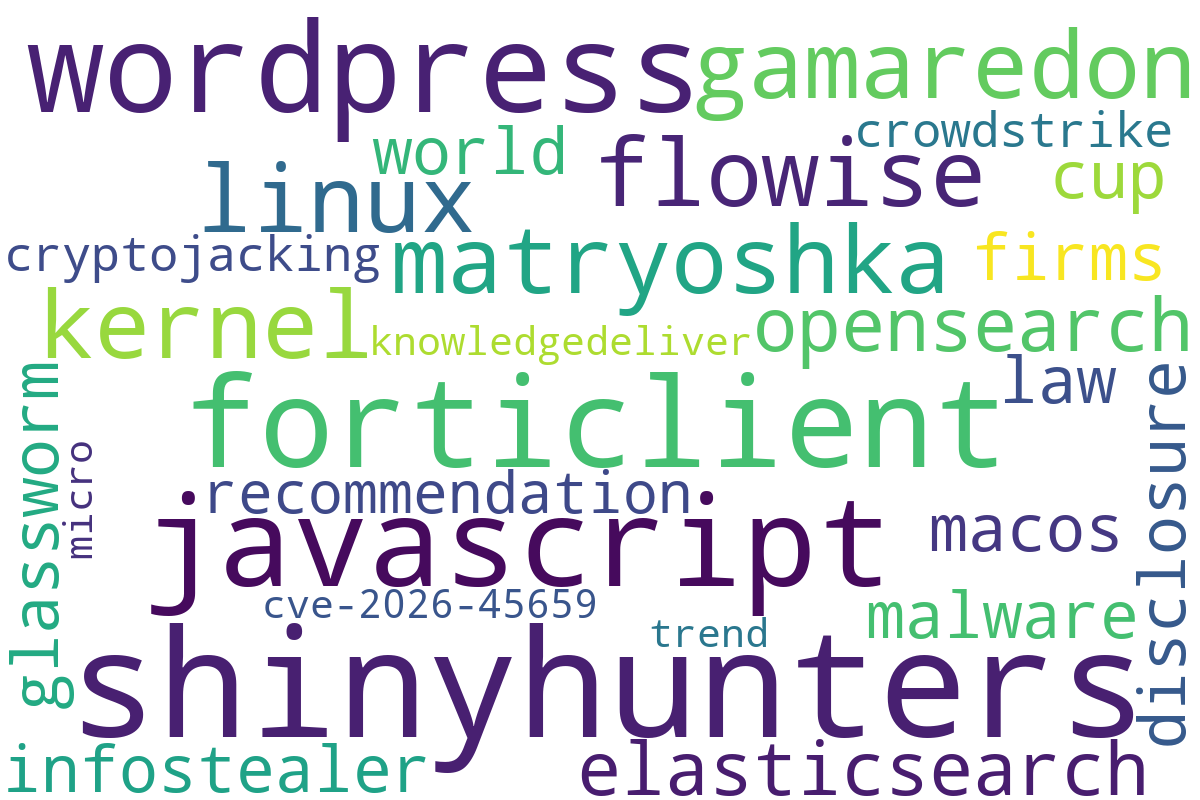
Weekly Coverage
Developments
Glassworm Botnet Takedown Shinyhunters Breaches Remotepe Rat (Lazarus) Symjack Ai Agent Rce
Vulnerabilities
CVE-2026-5426Knowledgedeliver (High)CVE-2026-27771CVE-2026-35616Forticlientems 7.4.5 (Critical)CVE-2026-39987Marimo < 0.23.0 (Critical)CVE-2026-9872CVE-2026-9873CVE-2026-9874CVE-2026-9875CVE-2026-9876CVE-2026-40933
Threat Groups
Scattered SpiderScattered Spider is a native Englishspeaking cybercriminal group active since at least 2022. The group initially targeted customer relationship management (CRM) providers, business process outsourcing (BPO) firms, and telecommunications and technology companies before expanding in 2023 to gaming, hospitality, retail, managed service provider (MSP), manufacturing, and financial sectors. Scattered Spider relies heavily on social engineering, including impersonating IT and helpdesk staff, to gain initial access, bypass multifactor authentication (MFA), and compromise enterprise networks. The group has adapted its tooling to evade endpoint detection and response (EDR) defenses and used ransomware for financial gain. Scattered Spider had expanded into hybrid cloud and identity environments, using helpdesk impersonation and MFA bypass to obtain administrator access in Okta, AWS, and Office 365.PlayPlay is a ransomware group that has been active since at least 2022 deploying Playcrypt ransomware against the business, government, critical infrastructure, healthcare, and media sectors in North America, South America, and Europe. Play actors employ a doubleextortion model, encrypting systems after exfiltrating data, and are presumed by security researchers to operate as a closed group.AkiraAkira is a ransomware variant and ransomware deployment entity active since at least March 2023. Akira uses compromised credentials to access singlefactor external access mechanisms such as VPNs for initial access, then various publiclyavailable tools and techniques for lateral movement. Akira operations are associated with "double extortion" ransomware activity, where data is exfiltrated from victim environments prior to encryption, with threats to publish files if a ransom is not paid. Technical analysis of Akira ransomware indicates variants capable of targeting Windows or VMWare ESXi hypervisors and multiple overlaps with Conti ransomware.LAPSUS$LAPSUS$ is cyber criminal threat group that has been active since at least mid2021. LAPSUS$ specializes in largescale social engineering and extortion operations, including destructive attacks without the use of ransomware. The group has targeted organizations globally, including in the government, manufacturing, higher education, energy, healthcare, technology, telecommunications, and media sectors.APT28APT28 is a threat group that has been attributed to Russia's General Staff Main Intelligence Directorate (GRU) 85th Main Special Service Center (GTsSS) military unit 26165. This group has been active since at least 2004. APT28 reportedly compromised the Hillary Clinton campaign, the Democratic National Committee, and the Democratic Congressional Campaign Committee in 2016 in an attempt to interfere with the U. S. presidential election. In 2018, the US indicted five GRU Unit 26165 officers associated with APT28 for cyber operations (including closeaccess operations) conducted between 2014 and 2018 against the World AntiDoping Agency (WADA), the US AntiDoping Agency, a US nuclear facility, the Organization for the Prohibition of Chemical Weapons (OPCW), the Spiez Swiss Chemicals Laboratory, and other organizations. Some of these were conducted with the assistance of GRU Unit 74455, which is also referred to as Sandworm Team.CHROMIUMEarth Lusca is a suspected Chinabased cyber espionage group that has been active since at least April 2019. Earth Lusca has targeted organizations in Australia, China, Hong Kong, Mongolia, Nepal, the Philippines, Taiwan, Thailand, Vietnam, the United Arab Emirates, Nigeria, Germany, France, and the United States. Targets included government institutions, news media outlets, gambling companies, educational institutions, COVID19 research organizations, telecommunications companies, religious movements banned in China, and cryptocurrency trading platforms; security researchers assess some Earth Lusca operations may be financially motivated. Earth Lusca has used malware commonly used by other Chinese threat groups, including APT41 and the Winnti Group cluster, however security researchers assess Earth Lusca's techniques and infrastructure are separate.Lazarus GroupLazarus Group is a North Korean statesponsored cyber threat group attributed to the Reconnaissance General Bureau (RGB). Lazarus Group has been active since at least 2009 and is reportedly responsible for the November 2014 destructive wiper attack on Sony Pictures Entertainment, identified by Novetta as part of Operation Blockbuster. Malware used by Lazarus Group correlates to other reported campaigns, including Operation Flame, Operation 1Mission, Operation Troy, DarkSeoul, and Ten Days of Rain. North Korea’s cyber operations have shown a consistent pattern of adaptation, forming and reorganizing units as national priorities shift. These units frequently share personnel, infrastructure, malware, and tradecraft, making it difficult to attribute specific operations with high confidence. Public reporting often uses “Lazarus Group” as an umbrella term for multiple North Korean cyber operators conducting espionage, destructive attacks, and financially motivated campaigns.Salt TyphoonSalt Typhoon is a People's Republic of China (PRC) statebacked actor that has been active since at least 2019 and responsible for numerous compromises of network infrastructure at major U. S. telecommunication and internet service providers (ISP).MuddyWaterMuddyWater is a cyber espionage group assessed to be a subordinate element within Iran's Ministry of Intelligence and Security (MOIS). Since at least 2017, MuddyWater has targeted a range of government and private organizations across sectors, including telecommunications, local government, defense, and oil and natural gas organizations, in the Middle East, Asia, Africa, Europe, and North America.Contagious InterviewContagious Interview is a North Korea–aligned threat group active since 2023. The group conducts both cyberespionage and financially motivated operations, including the theft of cryptocurrency and user credentials. Contagious Interview targets Windows, Linux, and macOS systems, with a particular focus on individuals engaged in software development and cryptocurrencyrelated activities.