Curated cybersecurity briefings on active threats, vulnerabilities, and emerging risks
Weekly Cybersecurity Briefing (11 May – 17 May 2026)
Published: Loading…
This briefing covers 249 reports published from 11 May to 17 May 2026.
At a Glance
- TeamPCP's coordinated supply chain campaign compromised over 80 TanStack npm packages, Bitwarden CLI, and PyPI libraries by abusing GitHub Actions OIDC tokens.
- ShinyHunters exploited Instructure's Canvas Free-For-Teacher service, stealing 3.65 TB of data from 275 million records across 8,809 educational institutions.
- Microsoft May Patch Tuesday addressed 120 vulnerabilities, including a critical zero-click Outlook RCE flaw exploitable through the Preview Pane.
- Foxconn confirmed a Nitrogen ransomware attack on North American factories, with attackers claiming theft of 8 TB of internal engineering data.
- Cisco Catalyst SD-WAN CVE-2026-20182 was added to CISA's KEV catalog following active exploitation enabling unauthenticated administrative access.
Summary
Supply chain attacks, ransomware incidents, and critical infrastructure vulnerabilities defined a turbulent week across the cybersecurity landscape.
- TeamPCP's expanding supply chain campaign compromised over 80 TanStack npm packages, Bitwarden CLI, and PyPI libraries including OpenSearch and Mistral AI, using GitHub Actions OIDC token theft to publish malicious versions.
- ShinyHunters breached Instructure's Canvas Free-For-Teacher platform on 25 April 2026, exfiltrating 3.65 TB of data covering 275 million records from nearly 9,000 educational institutions, before shifting to school-by-school extortion.
- Microsoft's May Patch Tuesday resolved 120 vulnerabilities, including a critical zero-click remote code execution flaw in Outlook and Word (CVE-2026-40361) exploitable via the Preview Pane, and no zero-days were disclosed.
- Foxconn confirmed a Nitrogen ransomware attack affecting North American factories, with attackers claiming theft of 8 TB of data including schematics linked to Apple, Nvidia, Google, Dell and Intel.
- Cisco Catalyst SD-WAN CVE-2026-20182 was added to CISA's Known Exploited Vulnerabilities catalog, with active exploitation enabling authentication bypass and webshell deployment by threat actor UAT-8616.
- The Gentlemen ransomware-as-a-service operation suffered an internal data leak, exposing affiliate coordination, infrastructure details, ransom negotiations and roughly 332 published victims during 2026.
Highlights of the Week
TeamPCP Supply Chain Worm Hits TanStack, Bitwarden and PyPI Ecosystems
Socket and Wiz researchers identified malicious code across 84 compromised npm packages under the TanStack namespace, including @tanstack/react-router, where attackers injected an obfuscated credential stealer targeting GitHub Actions, AWS, Kubernetes and HashiCorp Vault environments. The attack exploited a pull_request_target workflow misconfiguration and GitHub Actions cache poisoning to obtain OIDC tokens, enabling valid signed package publication without compromising maintainer credentials. Trend Micro linked the campaign to TeamPCP, connecting it to earlier compromises of Checkmarx KICS, elementary-data and a trojanised @bitwarden/cli v2026.4.0 package distributed via Docker Hub and PyPI.
ShinyHunters Extorts Schools After Canvas Data Theft
Halcyon reported that ShinyHunters exploited a vulnerability in Instructure's Canvas Free-For-Teacher service on 25 April 2026, claiming theft of 3.65 TB of data containing roughly 275 million records from 8,809 educational institutions. Exposed data included names, institutional email addresses, student ID numbers and Canvas inbox messages, while the group later defaced login portals at around 330 schools after an initial ransom deadline passed. ShinyHunters subsequently shifted from demanding a single payment from Instructure to targeting affected schools individually, with a final negotiation deadline set for 12 May 2026.
Microsoft Patches Zero-Click Outlook RCE Flaw in May Patch Tuesday
Microsoft May 2026 Patch Tuesday resolved 120 vulnerabilities across Windows and applications, including 17 critical issues and no zero-days. CVE-2026-40361, a critical use-after-free flaw in a shared Microsoft Word and Outlook DLL, enables remote code execution when a victim previews or reads a specially crafted email, with the Preview Pane confirmed as an attack vector. Researcher Haifei Li noted the flaw allows zero-click attacks in Exchange Server environments, affecting Microsoft 365 Apps, Office 2019, Office LTSC and Word 2016.
Foxconn Confirms North American Factories Hit by Nitrogen Ransomware
Foxconn confirmed that several North American factories were impacted by a cyberattack attributed to the Nitrogen ransomware group, which listed the company on its leak site. Attackers claimed theft of approximately 8 TB of data comprising over 11 million files, including confidential documents and schematics linked to Apple, Intel, Google, Dell and Nvidia. Foxconn stated that its cybersecurity team activated incident response procedures and that affected facilities are resuming normal production while investigations continue.
Threats
Kazuar Backdoor Evolves into Modular P2P Botnet
Microsoft Threat Intelligence detailed how Secret Blizzard, a Russian state-aligned threat actor, restructured the Kazuar backdoor into a modular peer-to-peer botnet targeting government and diplomatic organisations in Europe and Central Asia. The updated architecture uses Kernel, Bridge and Worker modules with leader election and inter-process communication via named pipes, mailslots and Windows messaging, reducing observable network activity. Command-and-control channels leverage HTTP, Exchange Web Services and WebSocket transport alongside anti-analysis checks, staged exfiltration and distributed data collection workflows.
BlackFile Operation Uses AiTM Vishing to Breach SaaS Platforms
Google Threat Intelligence Group tracked UNC6671, operating as BlackFile, conducting voice phishing campaigns that deploy adversary-in-the-middle techniques to compromise Microsoft 365 and Okta SSO environments in real time. The group captures credentials and MFA tokens before registering attacker-controlled MFA devices, then uses Python and PowerShell scripts leveraging Microsoft Graph APIs and session cookies to exfiltrate data from SharePoint, OneDrive, Salesforce and Zendesk at scale. Post-compromise activity is recorded as FileAccessed events, supporting extortion operations linked to the ShinyHunters and Scattered Spider ecosystems.
The Gentlemen Ransomware Leak Exposes Internal Operations
Check Point Research analysed leaked internal chats and backend data from The Gentlemen ransomware-as-a-service operation, exposing nine operator accounts, affiliate coordination, ransom negotiations and infrastructure linked to roughly 332 published victims during 2026. Leaked conversations identified eight affiliate TOX IDs tied to 29 ransomware campaigns and showed administrator zeta88 directly deploying ransomware and managing payouts. The leak also revealed the group's evaluation of CVE-2024-55591, CVE-2025-32433 and CVE-2025-33073 for network intrusions using Fortinet and Cisco edge devices.
TrickMo Android Banking Malware Routes C2 Traffic Through TON
ThreatFabric identified a redesigned TrickMo Android banking malware variant targeting banking, fintech and authenticator applications in France, Italy and Austria through campaigns masquerading as TikTok and streaming apps. The malware routes command-and-control traffic through The Open Network using embedded TON proxy infrastructure and .adnl endpoints, retaining capabilities including credential theft, screen streaming, SMS interception and full device remote control through abused accessibility services. The updated variant adds SSH tunnelling, SOCKS5 proxying and DNS reconnaissance commands, enabling compromised devices to function as encrypted network pivots.
Infrastructure & Exploits
Cisco SD-WAN Authentication Bypass Under Active Exploitation
CISA added CVE-2026-20182, an authentication bypass vulnerability in Cisco Catalyst SD-WAN Controller and Manager, to its Known Exploited Vulnerabilities catalog following confirmed active exploitation attributed to UAT-8616. Cisco Talos reported that multiple post-compromise clusters deployed webshells including XenShell, Godzilla and Behinder, alongside AdaptixC2, Sliver implants, XMRig mining and Nim-based backdoors. Additional flaws CVE-2026-20133, CVE-2026-20128 and CVE-2026-20122 in Cisco SD-WAN Manager were also exploited via publicly released proof-of-concept code.
Fragnesia Linux Kernel Flaw Enables Root via Page Cache Corruption
Researchers disclosed Fragnesia, a local privilege escalation vulnerability in the Linux kernel's XFRM ESP-in-TCP subsystem tracked as CVE-2026-46300, affecting kernels prior to the 13 May 2026 patch. The flaw stems from improper handling of shared page fragments during skb coalescing, enabling attackers to manipulate AES-GCM decryption in queued TCP data and overwrite cached binaries such as /usr/bin/su without modifying files on disk. Researchers demonstrated exploitation using user and network namespaces with CAP_NET_ADMIN, while Ubuntu AppArmor restrictions on unprivileged user namespaces may partially mitigate the attack path.
cPanel Authentication Bypass Exploited to Deploy Persistent Backdoors
Qianxin XLab reported active exploitation of CVE-2026-41940, a critical unauthenticated authentication bypass in cPanel and WHM with a CVSS score of 9.8, by a threat group tracked as Mr_Rot13. Attackers deployed a Go-based infector that changes root passwords, implants SSH keys, installs PHP webshells and injects credential-stealing JavaScript into cPanel login pages, alongside a cross-platform backdoor named Filemanager for remote administration. XLab linked the activity to infrastructure dating back to 2020, including a previously undetected PHP backdoor uploaded to VirusTotal in 2022 using ROT13 and RC4 obfuscation.
Windows Zero-Days YellowKey and GreenPlasma Enable BitLocker Bypass
Researchers disclosed two unpatched Windows zero-days, YellowKey and GreenPlasma, enabling BitLocker bypass and SYSTEM-level privilege escalation on Windows 11, Server 2022 and Server 2025. YellowKey exploits Windows Recovery Environment FsTx directory handling to bypass BitLocker via physical access during a reboot, while GreenPlasma enables privilege escalation to SYSTEM through arbitrary memory section object creation in SYSTEM-writable directory objects. A separate MiniPlasma proof-of-concept abuses the cldflt.sys Cloud Filter driver to achieve SYSTEM privileges on fully patched Windows 11 builds.
Microsoft Exchange XSS Flaw Exploited Through Crafted OWA Emails
Microsoft disclosed CVE-2026-42897, a critical spoofing vulnerability in on-premises Exchange Server caused by a cross-site scripting flaw actively exploited in the wild. The vulnerability allows attackers to send crafted emails that execute arbitrary JavaScript in Outlook Web Access browser sessions, affecting Exchange Server 2016, Exchange Server 2019 and Exchange Server Subscription Edition, with Exchange Online unaffected. Microsoft issued temporary mitigations through the Exchange Emergency Mitigation Service while a permanent update is being developed.
Intel and AMD Address 70 Vulnerabilities Across Product Lines
Intel and AMD released more than two dozen advisories during May 2026 Patch Tuesday, addressing 70 vulnerabilities affecting graphics drivers, firmware, processors and cloud management software. Intel patched a critical buffer overflow flaw CVE-2026-20794 in the Data Center Graphics Driver for VMware ESXi, while AMD fixed CVE-2026-0481 in the ROCm Device Metrics Exporter, which exposed an unauthenticated GPU-Agent gRPC service on port 50061. Additional high-severity issues affected Intel EMA, Vision software and QuickAssist Technology drivers, alongside AMD Secure Processor, EPYC platforms and Zen 2 cache operations.
Tools & Techniques
Google Links AI Tools to Zero-Day Exploit Development and Malware
Google Threat Intelligence Group reported that cybercriminals used an AI-generated Python exploit to target a zero-day two-factor authentication bypass flaw in a popular open-source web administration platform during a planned mass exploitation campaign. The report also described PROMPTSPY, an Android backdoor that uses the Gemini API to autonomously navigate device interfaces, replay biometric authentication gestures and execute commands through accessibility services. Google linked additional AI-enabled activity to PRC, DPRK and Russia-aligned threat actors using large language models for exploit research, malware obfuscation, phishing reconnaissance and deepfake operations.
AMOS macOS Infostealer Spreads via ClickFix Terminal Trick
Sophos MDR reported an AMOS macOS infostealer variant delivered through ClickFix-style social engineering that tricks users into executing Terminal commands, initiating a bootstrap script downloading secondary payloads with elevated privileges. The malware validates passwords locally, harvests macOS Keychain data, browser profiles and cryptocurrency wallet contents, performs virtual machine checks and establishes LaunchDaemon persistence before exfiltrating archived data to attacker-controlled servers. The campaign targets macOS users specifically through staged payload execution designed to evade standard endpoint detection methods.
GemStuffer Campaign Uses RubyGems to Exfiltrate UK Council Data
Socket identified a campaign named GemStuffer that published more than 155 malicious RubyGems packages which scraped UK local government ModernGov portals and exfiltrated collected data through uploaded .gem archives. Payloads fetched calendar and committee pages from Lambeth, Wandsworth and Southwark council portals, embedded the responses into valid gem packages, then pushed them to RubyGems using hardcoded API tokens. Ruby Central temporarily disabled new account registrations and throttled webhooks while responding to the coordinated spam-publishing activity.
AD CS Misconfigurations Abused for Privilege Escalation in Enterprise Environments
Palo Alto Networks Unit 42 detailed how attackers are abusing Active Directory Certificate Services misconfigurations, including ESC1 template flaws and shadow credentials, to impersonate privileged accounts and maintain persistent access. Tools including Certify, Certipy and pyWhisker are being used to exploit permissive certificate templates, manipulate the msDS-KeyCredentialLink attribute and obtain Kerberos tickets through PKINIT authentication. Unit 42 linked these techniques to ransomware and state-backed operations, citing exploitation of CVE-2022-26923 and recent investigations involving Fighting Ursa and Fog ransomware.
Policy & Legal
G7 Agencies Publish Minimum Elements for AI Software Bills of Materials
Cyber agencies from G7 nations and the European Commission published guidance defining minimum elements for Software Bills of Materials applied to AI systems, aiming to improve supply-chain transparency and cybersecurity across public and private sectors. The framework outlines seven clusters covering metadata, models, datasets, infrastructure, security properties and software dependencies, while noting that AI SBOMs alone are insufficient for supply-chain protection. The guidance states that AI SBOMs should integrate with vulnerability management tools, security advisories and broader cybersecurity monitoring mechanisms.
German and Spanish Police Dismantle Relaunched Crimenetwork Marketplace
German and Spanish authorities arrested a 35-year-old German national in Mallorca accused of rebuilding the Crimenetwork dark web marketplace days after its original administrator was arrested in December 2024. The relaunched platform accumulated more than 22,000 users, over 100 vendors and generated more than €3.6 million in revenue through commissions and seller licensing fees, trading stolen data, drugs and forged documents. Germany's BKA seized €194,000 in assets alongside user and transaction data, while the original Crimenetwork processed at least 1,000 BTC and 20,000 XMR between 2018 and 2024.
Checkmarx Jenkins Plugin Compromised in Linked Supply Chain Attack
Checkmarx disclosed that a malicious version of its Jenkins AST Scanner plugin was published to the Jenkins Marketplace between 9 and 10 May 2026, affecting CI/CD pipelines using vulnerable plugin versions. The company released clean plugin versions including 2.0.13-848.v76e89de8a_053 and linked the compromise to the March 2026 TeamPCP attack on Trivy, which enabled unauthorised GitHub repository access and publication of malicious artefacts. Subsequent data leaks from the incident were attributed to the Lapsus$ extortion group.
Weekly Topic Distribution
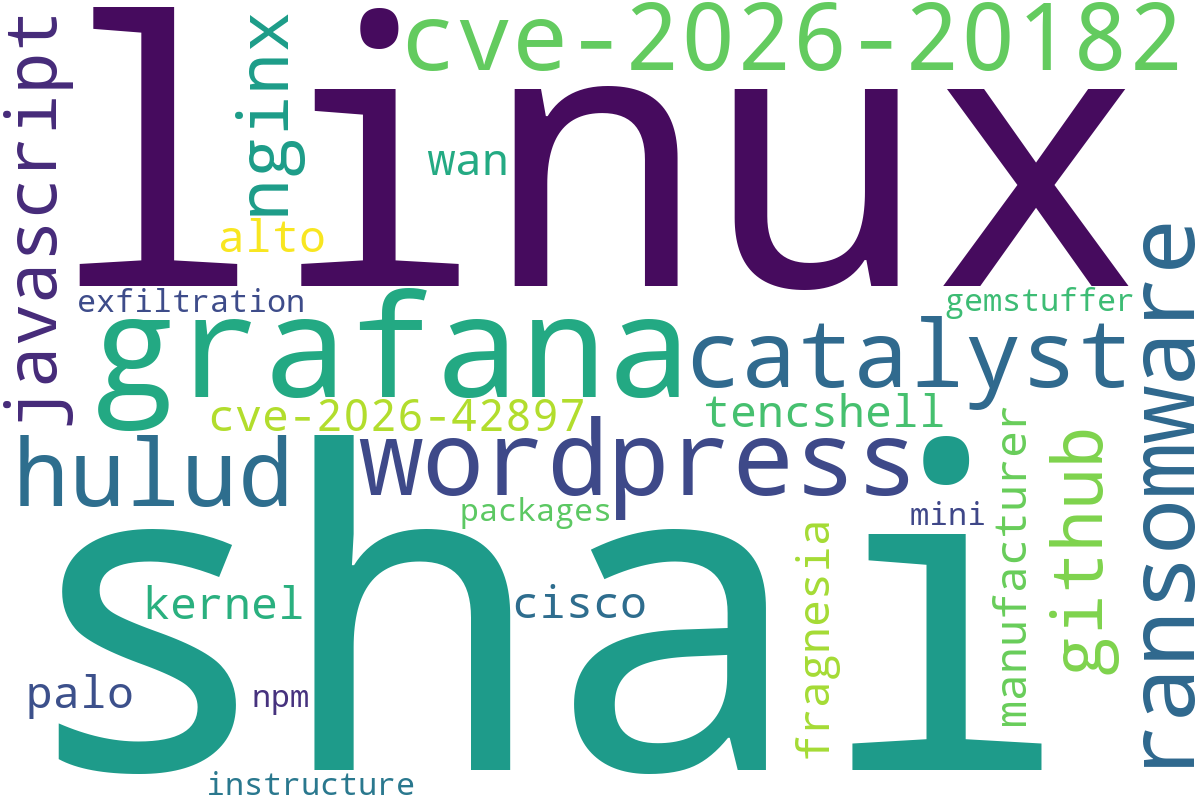
Weekly Coverage
Developments
Teampcp Supply Chain Campaign Tanstack Npm Compromise Shinyhunters Canvas Breach Nitrogen Ransomware / Foxconn
Vulnerabilities
CVE-2026-20182Cisco Catalyst Sd-Wan Manager 20.1.12 (Critical)CVE-2026-41940Cpanel 11.110.0 (Critical)CVE-2026-40361CVE-2024-55591CVE-2025-32433CVE-2025-33073Windows_10_1507 10.0.10240.21034 (High)CVE-2026-20133Cisco Catalyst Sd-Wan Manager 20.1.12 (Medium)CVE-2026-20128CVE-2026-20122CVE-2026-46300
Threat Groups
Scattered SpiderScattered Spider is a native Englishspeaking cybercriminal group active since at least 2022. The group initially targeted customer relationship management (CRM) providers, business process outsourcing (BPO) firms, and telecommunications and technology companies before expanding in 2023 to gaming, hospitality, retail, managed service provider (MSP), manufacturing, and financial sectors. Scattered Spider relies heavily on social engineering, including impersonating IT and helpdesk staff, to gain initial access, bypass multifactor authentication (MFA), and compromise enterprise networks. The group has adapted its tooling to evade endpoint detection and response (EDR) defenses and used ransomware for financial gain. Scattered Spider had expanded into hybrid cloud and identity environments, using helpdesk impersonation and MFA bypass to obtain administrator access in Okta, AWS, and Office 365.PlayPlay is a ransomware group that has been active since at least 2022 deploying Playcrypt ransomware against the business, government, critical infrastructure, healthcare, and media sectors in North America, South America, and Europe. Play actors employ a doubleextortion model, encrypting systems after exfiltrating data, and are presumed by security researchers to operate as a closed group.LAPSUS$LAPSUS$ is cyber criminal threat group that has been active since at least mid2021. LAPSUS$ specializes in largescale social engineering and extortion operations, including destructive attacks without the use of ransomware. The group has targeted organizations globally, including in the government, manufacturing, higher education, energy, healthcare, technology, telecommunications, and media sectors.AkiraAkira is a ransomware variant and ransomware deployment entity active since at least March 2023. Akira uses compromised credentials to access singlefactor external access mechanisms such as VPNs for initial access, then various publiclyavailable tools and techniques for lateral movement. Akira operations are associated with "double extortion" ransomware activity, where data is exfiltrated from victim environments prior to encryption, with threats to publish files if a ransom is not paid. Technical analysis of Akira ransomware indicates variants capable of targeting Windows or VMWare ESXi hypervisors and multiple overlaps with Conti ransomware.APT28APT28 is a threat group that has been attributed to Russia's General Staff Main Intelligence Directorate (GRU) 85th Main Special Service Center (GTsSS) military unit 26165. This group has been active since at least 2004. APT28 reportedly compromised the Hillary Clinton campaign, the Democratic National Committee, and the Democratic Congressional Campaign Committee in 2016 in an attempt to interfere with the U. S. presidential election. In 2018, the US indicted five GRU Unit 26165 officers associated with APT28 for cyber operations (including closeaccess operations) conducted between 2014 and 2018 against the World AntiDoping Agency (WADA), the US AntiDoping Agency, a US nuclear facility, the Organization for the Prohibition of Chemical Weapons (OPCW), the Spiez Swiss Chemicals Laboratory, and other organizations. Some of these were conducted with the assistance of GRU Unit 74455, which is also referred to as Sandworm Team.CHROMIUMEarth Lusca is a suspected Chinabased cyber espionage group that has been active since at least April 2019. Earth Lusca has targeted organizations in Australia, China, Hong Kong, Mongolia, Nepal, the Philippines, Taiwan, Thailand, Vietnam, the United Arab Emirates, Nigeria, Germany, France, and the United States. Targets included government institutions, news media outlets, gambling companies, educational institutions, COVID19 research organizations, telecommunications companies, religious movements banned in China, and cryptocurrency trading platforms; security researchers assess some Earth Lusca operations may be financially motivated. Earth Lusca has used malware commonly used by other Chinese threat groups, including APT41 and the Winnti Group cluster, however security researchers assess Earth Lusca's techniques and infrastructure are separate.Salt TyphoonSalt Typhoon is a People's Republic of China (PRC) statebacked actor that has been active since at least 2019 and responsible for numerous compromises of network infrastructure at major U. S. telecommunication and internet service providers (ISP).MuddyWaterMuddyWater is a cyber espionage group assessed to be a subordinate element within Iran's Ministry of Intelligence and Security (MOIS). Since at least 2017, MuddyWater has targeted a range of government and private organizations across sectors, including telecommunications, local government, defense, and oil and natural gas organizations, in the Middle East, Asia, Africa, Europe, and North America.Lazarus GroupLazarus Group is a North Korean statesponsored cyber threat group attributed to the Reconnaissance General Bureau (RGB). Lazarus Group has been active since at least 2009 and is reportedly responsible for the November 2014 destructive wiper attack on Sony Pictures Entertainment, identified by Novetta as part of Operation Blockbuster. Malware used by Lazarus Group correlates to other reported campaigns, including Operation Flame, Operation 1Mission, Operation Troy, DarkSeoul, and Ten Days of Rain. North Korea’s cyber operations have shown a consistent pattern of adaptation, forming and reorganizing units as national priorities shift. These units frequently share personnel, infrastructure, malware, and tradecraft, making it difficult to attribute specific operations with high confidence. Public reporting often uses “Lazarus Group” as an umbrella term for multiple North Korean cyber operators conducting espionage, destructive attacks, and financially motivated campaigns.Contagious InterviewContagious Interview is a North Korea–aligned threat group active since 2023. The group conducts both cyberespionage and financially motivated operations, including the theft of cryptocurrency and user credentials. Contagious Interview targets Windows, Linux, and macOS systems, with a particular focus on individuals engaged in software development and cryptocurrencyrelated activities.